Pages

Monday, November 18, 2013

Review of Public Enemy by Bill Ayers


Review of Public Enemy: Confessions of An American Dissident
Bill Ayers
(Beacon, 2013)

Bill Ayers and the Radical ‘Spark’ – Past and Present

“They just don’t get it.”  Yes, the phrase is overused, yet, all too appropriate when addressing the continuing critiques, from both the left and the right, of Bill Ayers. The recent publication of the second phase of his memoir, Public Enemy: Confessions of An American Dissident, was followed on the “SDS and ‘60s Leftists” page of Facebook by an un-thoughtful conversation on Ayers, his comrade and wife Bernardine Dohrn, and the Weather Underground (WO).  Facilitated by George Fish and responding to a negative book review by Jon Wiener, 43 comments followed Fish’s post.  Mostly sour, bitter, and ahistorical in tone, the comments provide the antithesis of Ayers’ book and life, that of learning from the past and continuing, in a human and life affirming way, the ongoing struggle that began for Ayers in the civil rights movement, antiwar movement, Students for A Democratic Society, and then the Weather Underground.

When confronted by a radio interviewer who referred to the sub-title as snide, Ayers softly replied that the entire title was chosen for its irony.  Missing both the breadth and depth of Public Enemy, the interviewer as well as Wiener and other critics fail to acknowledge the thoughtfulness and energy that Ayers brings to struggle, both past and present.  In this particular book, we alternate between the author’s recollections of first, his experience in the 2008 attempt to demonize Barack Obama because he “palled around with terrorists,” and, second, the years after he surfaced from underground beginning in 1980 from where Ayers left-off in his previous book, Fugitive Days.  There are both multiple and complex events, issues, and ideas presented in Public Enemy.  A sampling will be discussed in this review.

Recently, South African anti-apartheid struggle leader and Constitutional Court Justice (comparable to the U.S. Supreme Court) Albie Sachs spoke at Pacific University in Forest Grove, Oregon.  Talking about his country’s Truth and Reconciliation Commission (TRC), Sachs emphasized the importance of acknowledgement for both personal and political healing.  Acknowledgement causes me to return to the radio interviewer’s portrayal of Confessions of An American Dissident as snide. In fact, irony aside, Ayers responded by talking about acknowledging one particular flaw during his time in WO.  He asserted that neither he nor his comrades ever doubted their positions and that by not being skeptical they were arrogant and without reflection.  Doubt is discussed in Public Enemy and Ayers also talks about apologetics within a conceptual framework of an American Truth Commission.  In both the book and current media interviews, Ayers has continually repeated that neither he nor the WO ever killed anyone in the bombings of buildings.

Not only did I never kill or injure anyone, but in the six years of its existence, the Weather Underground never killed or injured anyone either.  We crossed lines of legality to be sure, of propriety, and perhaps even of common sense, but it was restrained, and those are the simple, straightforward facts.

The correct term for Weather Underground bombings, in correspondence to the armed struggle in South Africa, is “armed propaganda.”  And like Umkhonto We Sizwe underground soldiers in South Africa, Ayers would welcome the opportunity to answer queries about his WO activities at an American TRC.  In Public Enemy Ayers writes:

America, it seemed to me, was in urgent need of some kind of truth and reconciliation process… We needed a process to understand the truth of the past in order to create the possibility of a more balanced future… Everyone together would have the opportunity to tell their stories of suffering, and the victimizers would be asked why and how they created that misery.  Society would have the opportunity to witness all of it in order to understand the extent and depth of the disaster as a step toward putting it behind us and moving forward.  In that setting and standing with Kissinger and McCain, McNamara and Kerry, Bush and Cheney, I’d be happy to say exactly what I did, take full responsibility, and bow deeply.  But without any chain of culpability whatsoever, I’ll stand on the record, or just stand aside.

While five chapters in Public Enemy present the threats and black listing Bill Ayers experienced during and after the 2008 presidential campaign, I will address the topic with brevity as it has already been explored in other reviews.  An in-depth description and analysis is portrayed in Maya Schwenwar’s Truthout review, “Bill Ayers Weighs in on Democracy, Selfhood, and His ‘Unrepentant Terrorist’ Alter-Ego.”  Besides endless email threats and having someone actually come to his office at the University of Illinois-Chicago, Ayers was banned from talking on college campuses throughout the country.  At the time my colleague at the University of South Carolina, Craig Kridel, the Curator of the Museum of Education, posted a page titled “The Bill Ayers Problem” on the Museum webpage.  The page title, like Public Enemy, is ironic and at the time I wrote:

The inequality, unfairness, violence, and global greed are what Bill Ayers has fought against for many years. The fight is every bit as important today as it was during the Civil Rights Movement and the Viet Nam War. And while some people might call me insensitive because I refuse to enter a debate on Bill Ayers as a terrorist, I choose not to speak back to the cries of O’Reilly, Hannity, and Colmes and their nameless comrades because the work Bill Ayers is doing does not need defenders but, rather, supporters and allies that fight for a more just world. Finally, as an academic who works with teachers who fought against apartheid in South Africa, I can’t help but think that the same people who define Bill Ayers as a terrorist would have given that label to Nelson Mandela and his less known comrades during the struggle against the apartheid regime. We know now what history says about that – we can only hope that Bill Ayers and many other people continue their work as progressive educators and activists.

But Bill Ayers does not rail against his detractors in his writing.  Rather, while he is critical in a political/personal way of their harassment and silencing and analyzes their actions, his emphasis is a celebration of people who continue the struggle.  While the story of the cancellation of his talk at the University of Wyoming is politically important, from Ayers we learn more about the woman who fought for his right to speak.  More accurately, she fought for her own free speech.

‘I’m going to sue the university in federal court,’ she told me during our first conversation.  ‘And I’m claiming that it’s my free speech that’s been violated – I have the right to speak to anyone I want to, and right now I want to speak to you.’  She was young and unafraid, smart and sassy, her dreams being rapidly made and used – no fear, no regret.  I liked her immediately.  Meg’s approach struck me as quite brilliant – students (and not I) were indeed the injured party.

The University of Wyoming student won the case and Bill Ayers spoke on democracy and education with over 1,000 people at the University.  In discussing the event, he also honors his sister’s father-in-law, a retired United Church of Christ minister who drove a couple of hours to Laramie for the talk and told Bill: “‘The Lord moves in mysterious ways,’ he said with a wink and a smile gesturing with his Bible.  ‘If any of the crazy Christians get out of hand, he wants me to set them straight.’”

Ayers writes of other cancellations at places throughout the country.  The University of Nebraska stands out but only because he was in Tapai at the time and was woken with the news from a dean at three in the morning.  In contrast to Nebraska, there are brave academics at Millersville University and Georgia Southern University where Ayers was welcomed.  At Millersville administrators explained that it was their “duty and honor” to have him speak.  “It’s not about you personally, it’s about the mission and the meaning of the university.”

Honoring people throughout Bill Ayers’ journey is the stuff of Public Enemy.  One of the funniest yet potent tales is the reaction of Ayers’ comrade and friend, Michael Klonsky, when he was invited to give an education conference keynote address.  The organization told Klonsky that they had intended to invite Bill Ayers but that he was “too controversial and too radical.”  Klonsky scolded the inviter saying: “How dare you ask me to scab on Bill Ayers?”  When Ayers thanked him, he replied: “Defending you?  I wasn’t defending you, I was defending myself – I was deeply and personally offended when they said that your were too radical, and by implication that I wasn’t too radical.  I’m as radical as you are, motherfucker.”

Bill Ayers’ book is about issues, ideas, actions, and people – it is not solely about Bill Ayers.  Epsie Reyes was a colleague at the University of Illinois-Chicago.  She supported Hillary, not Barack, in the 2008 democratic primaries, and she was one of many people who consoled Bill Ayers after Hillary Clinton first demonized him in a primary presidential debate.  Reyes sent strong emails to both Clinton and the Democratic National Committee “detailing how much money she’d donated and how many weekends she’d devoted to organizing on her behalf, explaining who I really was in her ‘humble opinion,’ and encouraging, then demanding that the campaign apologize to me personally and denounce the smears – or else she would have to rethink her commitments.”

Close friends and colleagues, of course, also came through in both 2001 and 2008.  Mona and Rashid Khalidi were both supportive and insightful as were dozens of others.  In 2008 there was a surprise call from Edward Said: “Of course it’s painful for you personally, but cringing and going quiet is the worst thing you could do at this moment.  Your kids are watching you and your students too and a lot of others.  Don’t let them down.”

Said’s message corresponds to the entirety of Public Enemy.  Ayers celebrates political struggle and the people who try to sustain the fight.  Two quotes come to mind, the first from a speech by Paul Potter referred to in the book. “Don’t let your life make a mockery of your values.”  Margaret Meade’s words correspond to Potter’s connecting the personal to the collective.  “Never doubt that a small group of thoughtful, committed citizens can change the world.  Indeed, it’s the only thing that ever has.”  In addition to the 2001, 2008, and more recent stories, Public Enemy includes portraits from the time Bernardine and Bill came up from underground in 1980.  Ayers writes admiringly about his childrens’ pre-school teacher at the time, BJ, whom he refers to as “an inspired early childhood educator.”  “She was one of a kind, and everyone knew it.”  Ayers’ portrait of BJ brought a response in Ron Jacobs’
 Counterpunch article, “Get Bill Ayers,” “Indeed, the truest hero in the book is the family’s New York child care provider, BJ.”

On Bill’s journey we meet Bernardine’s lawyers Eleanora Kennedy and Michael Kennedy and various other people including Ellie and Robby Meeropol who were Bill’s friends at the University of Michigan.  Robby was the son of Ethel and Julius Rosenberg and he was three years old when his parents were executed.  Bernardine and Bill had just adopted Chesa Boudin whose parents, Kathy Boudin and David Gilbert, had been sentenced for murder in the Brinks Robbery in Nyack, New York.  Robby explained that there was no road map and that times would be rough for Chesa – honest responses are very much a part of the many vignettes that Ayers presents throughout Public Enemy.

The real heart of the book, however, within the context of continuing struggle, is the authentic portrayal of the Dohrn/Ayers family – Bernardine Dohrn and their sons Chesa, Malik, and Zayd.  The book depicts seriousness and humor and mostly respect and admiration.  There is a story from the early above ground days that I must include in this review.

Leaving swim class one day, we were swept up into a raucous women-led march heading from Broadway and Fifty-ninth Street toward Times Square.  ‘No more porn!  No more porn! No more porn!” we chanted ecstatically, fists pumping and voices rising as we entered the pornography district.  It was a feisty and colorful crowd, our attendance just a happy accident, but with Zayd cheerfully perched on my shoulders we were in high spirits and quite pleased to be in cahoots.  Soon we spotted a pizza stand along the route, and Zayd was famished from swimming and ready for a slice, so we settled into a booth.  Zayd reflected on the parade we’d just left: ‘That was fun,’ he said.  ‘Why don’t we want more corn?’

Ayers tells the story of all three sons advising him during 2008 and the respect appears to go both ways.  Pages 129 to 131 serve as an illustration as Malik, Zayd, and Chesa join Bernardine in coaxing Bill not to speak with the media – a disposition alien to his being.  Malik warns him of ambush and it recalls Mailer’s self-admonitions of never talk to the press – they control the story.

The consensus from them, in line with Bernardine’s steady and consistent basic instinct, was that whatever happened on the web or in the press, we should simply turn away.  No comment, no elaboration, no clarification, no response.  ‘Be completely quiet,’ they said, ‘and stay calm.’  ‘It’s harder then it sounds,’ Zayd added, looking right at me, ‘especially for you.’  True, too true: I tend to have a lot on my mind – who doesn’t? – and I’m genetically wired to speak up and speak out, and not always with considered judgment.  My default position, no matter what, is to say something… ‘You’ll get flattened,’ they now said in unison.’

Bill Ayers remained silent through 2008, but of course, “palling around with terrorists” quietly lives on.  There is an ethos throughout Public Enemy, consistently present in the ideas, issues, actions, and people portrayed in the book, amidst everything else – this book is homage to Bernardine Dohrn.  Her strength, thoughtfulness, commitment, and humanity is the spirit of Public Enemy: Confessions of An American Dissident.  Whether it is gently chiding Bill with their children or being warmly welcomed back by the judge in Chicago when she surfaced from underground – her humanity is ever present.  Political commitment is obvious in Dohrn’s first above ground statement: “This is no surrender.  The fight against racism and war continues, and I will spend my energy organizing to defeat the American empire.”  Ayers writes of her actions and dispositions when she was imprisoned at the Metropolitan Correctional Center in New York for refusing to give Grand Jury testimony on the Brinks Robbery.  The emotion of being away from her kids but at the same time focused political commitment.  There is also a great story of her mother passing on contraband when she visited the prison – a chocolate chip cookie!

There is much more to Public Enemy than the samples that I present.  Bill Ayers critiques the Weather Underground and provides much more breadth to the ideas, issues, actions, people, and events he portrays.  He also pushes his story to the present and therein lies the further message.  Ayers, Dohrn, and many of their WO (and beyond) comrades continue to work for the same issues they have pursued beginning in the sixties.  For Ayers it is education and more and the latter includes working with young activists who continue the fight for the end of racism, class disparity, and imperialism.  First in the civil rights movement, then SDS and WO, Ayers was part of the “spark” for a just world.  His book is a partial story of continuing to keep that “spark” alive today.

Alan Wieder

Alan Wieder is the author of Ruth First and Joe Slovo in the War Against Apartheid (Monthly Review Press, 2013)

Sunday, November 10, 2013

Retro-Review - Playbook for Progressives: 16 Qualities of the Successful Organizer - Eric Mann (Beacon Press, 2011)


Eric Mann's Playbook for Progressives is two books in one.  The book wouldn't work any other way.  Mann is true to his title and introduction, presentings a 74-page section on the roles of an organizer.  Included in this section are 12 specific yet overlapping responsibilities that are representative of political organizers -- foot soldier, evangelist, recruiter, group builder, strategist, tactician, communicator, political educator, agitator, fundraiser, comrade & confidante, and cadre.  The second section of the book,"16 Qualities of a Successful Organizer, takes the roles of the first section further by building on the earlier descriptions with substantive portraits of strategy and tactics that are crucial for successful radical, political, organizing.

Playbook for Progressives is not two books because it includes distinct sections, but rather because Mann combines theory and action, with biography and autobiography, to bring alive, through real lives, what radical organizing means in the struggle against racism and class disparity in the United States and throughout the world. 

Eric Mann one of the founders the Labor/Community Strategy Center (LCSC) in 1989, has been the organization's Director since its inception.  His earlier political work included being a Field Secretary for The Congress of Racial Equality, an aboveground member of Weatherman, and a radical, activist/organizer in automobile and airplane production plants throughout the country.  Many of the examples of radical organizing in the book are the stories of Mann and other organizers at LCSC.  Mann explains in the introduction of Playbook for Progressives that the organization was launched as "an experiment to reassert the powerful, positive impact of progressive ideology and transformative organizing." As an aspect of the rationale for the Center, Mann writes about 'activists' wanting seats at the tables of power -- an issue that might be even more problematic at the present time.

Labor and community organizers began talking about 'empowerment' rather than power, 'a seat at the table' rather than concrete demands and political independence, and 'public-private partnerships' rather that a challenge to the profit motive and corporate power.

Throughout the book there are also stories of many other organizers, some whose names we know and others that we don't, but all examples of people fighting class disparity and racism -- locally, nationally, and globally.  LCSC's largest undertaking is the Bus Rider's Union (BRU).  Founded in 1992, BRU's membership comprises mostly black people and Latina people who have organized to fight against the two-tiered discriminatory system of the Los Angeles Metropolitan Transportation Authority (MTA) and BRU's success is legendary beginning with a 1994 suit against the MTA that concluded with the court rescinding raised fares and bus passes.  The successes remain to this day -- of course the need for continuing this particular struggle illustrates the necessity of ongoing activism and organization.  Much more can be read about the BRU in Eric Mann's book.  While LCSC has various initiatives, the other one that I will highlight is the fight against the school-to-prison pipeline.  Briefly, LCSC is part of a coalition that has fought to de-criminalize truancy in Los Angeles -- again more of the story in Playbook for Progressives.

Mann is clear on the hard work, discipline, human warmth, and expertise necessary for progressive organizing.  He is very detailed describing and analyzing the theory and dispositions of radical activism.  "In the United States in particular, and among organizers in general, there is a pragmatic, antitheoretical tendency... The problem is that theory is an overview that gives you a map as to where you are going." Mann's detail is important, but the people's lives that he portrays wed the details to human actions.  I want people to read and re-read Playbook for Progressives.  Thus, until I come to this review's conclusion, I will provide brief portraits of Eric and a small sample of the other organizers he brings to his book.

As a young man in the mid-sixties, Mann worked with the Newark Community Union Project (NCUP) going door-to-door asking people to become involved in meetings and protests against racism and oppression.  There were sobering moments that might still occur in 2013.  Mann writes about one of the people he met:

She wanted to offer me food, but her refrigerator was almost bare.  She would bring me hot coffee, and we would sit and talk.  Once, perhaps influenced by Martin Luther King Jr.'s metaphor, I asked her if she had a dream of what her life could be like.  She told me, "My dream is that I am able to walk in front of a car and leave this life and God will not punish me for abandoning my children.

This is the "exceptional" United States of America.

And of course, the above quote speaks to the importance of Playbook for Progressives. While talking of the successes of the BRU, Mann speaks of four key elements for radical organizing.  Before citing the list Manns caveat is the Cabral quote, Tell no lies and claim no easy victories."

1.    Listen very carefully and let the person talk
2.    Show a deep concern about very specific conditions people face
3.    Present very concrete demands
4.    Frame the conversation within an up-front worldview of those fights as part of a larger social transformation

The process is exemplified in Eric's meeting and continuing work with Eduardo Fuentes in Wilmington, California where the toxic emissions of the oil companies was causing serious and sometimes fatal health conditions for the Latina (o) population.  LCSC's project was called Watchdog.  Eduardo approached Eric at a meeting and told him that his local organization, Parents Against Pollution, shared the values of Watchdog.  As Eric attempted to build a coalition of the two groups he learned that Eduardo was the group.  "I asked him how many parents were in the group and he said, 'One. Me.'"  More importantly, Eduardo was reticent about joining Watchdog.  Eric had written a book on the topic and the values and actions of LCSC on the issue clearly corresponded to those of Eduardo Fuentes -- yet he was leery.  As the two men met Eduardo asked about the action part of Watchdog -- picketing, sit-ins.  He then explained that in his native Guatemala "the government, with the support of the U.S. Central Intelligence Agency, kidnap and kill indigenous peoples, union leaders, and revolutionaries." Eduardo was also concerned about the anti-immigrant movement in the United States.  But Eric Mann had followed all four of the key elements of radical organizing cited above and spoke about the safeguards for the 'undocumented' in Watchdog actions.  Not only did Eduardo Fuentes join the project, he became a local leader in Wilmington.

Mann writes of strategy and provides more real life examples.  An illustration is the work of Manuel Criollo, who directs the organizing at LCSC.  There are stories from the Bus Riders Union and that of Deloros Huerta, the legendary United Farmworkers leader.  The third chapter of Section Two has the great title, Sings with the Choir but Finds Her Own Voice, the perfect mantra for organizing and a peoples socialism.  Another chapter, Generosity of Spirit: Take Good Care of Others, tells the early 1960s organizing story of The Newark Community Union Project, but also extends the camaraderie to the present as group organizers, living throughout the country, fight for the housing rights of Terry Jefferson, one of their comrades, now 87 years old.  Mann tells the tale of his activist work with Mark Masaoka at the Van Nuys General Motors plant in the 1980s.  And finally, not really as there are additional personal/political vignettes, Mann tells the story of the coalition of New York Domestic Workers and Shalom Bayit Jews for Racial and Economic Justice that culminated in the Domestic Workers Bill of Rights.

Corresponding to the peoples stories, Mann connects theory and practice and the many intricacies and complexities that they include.  The importance of the individual and the group is connected to conversation and reflection.

At the Strategy Center, I am fortunate to have close comrades who will take me aside, which I appreciate in itself, and explain to me things I have done that were arrogant, chauvinist, insensitive.  They will point out ways I have been inconsistent and even vacillatory changing my mind and contradicting something I said only a few days ago without realizing it.  They show me instances when I did not listen to or respect the ideas of others and assumed I was right, when in fact they understood the situation far better than I did.

Mann suggests that commitment and hard work needs to be connected to expertise with both national and global examples:
Organizers who are ill-informed about their issues can speak only the general truths of the revolution and are outmatched by the scientists and expert witnesses marshaled by their opponents.  They are usually unpersuasive, unable to effect actual change, and are used as caricatures by the system to discredit the movement.

After writing of expertise, and using more biographical and autobiographical examples, Mann explores militancy, bravery, and courage as necessary elements of radical organizing.  After telling the story of Maria Guardado: Salvadorian saint, Mann explains: The courageous example of individuals is critical, but courage must be found in a collective context.

Finally, Playbook for Progressives portrays the deeds of more well-known struggle leaders such as Audre Lorde.  Mann quotes Margaret Meade as a connector of organizing and revolutionary theory and practice and the comrades whom he portrays.

Never doubut that a small group of thoughtful, committed citizens can change the world.  Indeed, its the only thing that ever has.

Sunday, June 16, 2013

A Radical Line: From the Labor Movement to the Weather Underground, One Family’s Century of Conscience – A Retro-Review


Reading Neil Gordon’s novel and then viewing Robert Redford’s film, The Company You Keep, a fictitious portrayal of the Weather Underground Organization (WUO), led me to re-read Thai Jones’ book on his family – his mom and dad WUO people Eleanor Stein and Jeff Jones, as well as their parents, Albert Jones a Quaker and WWII conscientious objector and Annie and Arthur Stein, labor movement people and both members of the Communist Party.  While I actually liked Redford’s film and the book even more, A Radical Line is much more encompassing as it portrays generations and real lives in the continuing struggle for a democratic, socialist America – yes, Eleanor and Jeff and I think Thai, as well as many of their WUO comrades and their children, continue the fight today.

I had no intentions of writing a review as I began to re-read A Radical Line.  The story, though, is so engrossing, and Thai Jones’ combination of detail, thoughtfulness, and drama, pull you in as words bring depth to his extended family as well as collective, progressive struggle in the United States.  Jones’ craft as a writer combined with depth of story are poignant in the first two pages of the book as he describes his parents arrest through reflections of his own memories of the event as a four year old child.

There had to be something I could do to help my parents.  I made a fast survey of my possessions: a cowboy outfit, a coloring book, a stuffed Tyrannosaurus.  I opened the drawer of my little desk and picked up my child’s scissors.  The ends were rounded, and the blades were covered by blue plastic guards.  Bouncing them in my hand and snipping at the air, I considered putting on the cowboy hat and charging into the hallway with scissors blazing to defeat these men who had come to hurt our family.   Even then, I knew it was a battle against long odds.  But I didn’t realize it was a question that many in my family had already faced.  They had chosen to fight.

Throughout A Radical Line the progressive fights of Thai Jones’ extended families, WUO and earlier, are connected to the collective struggle against class disparity, racism, and the Viet Nam War.  Jeff Jones was raised in southern California and his father worked for Walt Disney Corporation.  But as already noted, Albert Jones was a pacifist, and his experience working as a conscientious objector at Civilian Public Service Camp #37 in Coleville, California during WWII is itself a story.  His path was not easy as his father disapproved and church people at the Methodist congregation that nurtured his views abandoned him – Camp #37 became home: “He was surrounded by pacifists.  Each Sunday they held a silent Quaker meeting, and that was the only time in the week that the men were not in heated discussions about their faith.  Coming here, Albert finally felt welcome.”

Jeff Jones’ early lessons were pacifism and peace and not a long leap to the civil rights movement and opposing the Viet Nam War.

Eleanor Stein’s parents were much more political.  Annie was introduced to socialism in high school and was politicized even further as a student at Hunter College.  Thai Jones describes her early participation in the National Student League and the communist party.  It was Annie who politicized Arthur.  Initially she was disheartened because her husband was apolitical, but she began leaving copies of The Daily Worker around their apartment and soon Arthur was attending meetings and demonstrations.

Like Albert Jones’s life-long commitment to non-violence, Annie and Arthur Stein never stopped fighting class disparity and racism.  While Thai Jones is much more descriptive on their lives than I can be in this short review, it is his description of their lives, including Albert’s assertion to Jeff before the Days of Rage: “Son, I believe very strongly in your goals.  But if you set out to hurt somebody, I would hope and pray that you are hurt first.” Concurrently, Eleanor was clearly nurtured by Annie’s work with civil rights stalwart Mary Church Terrell and her political work on education in NYC.  She was also nurtured by her father’s labor activism, his founding of the Fair Play for Cuba Committee chapter in Brooklyn, and his appearance before the HUAC where he was represented by Victor Rabinowitz, the attorney who also represented Paul Robeson and Pete Seeger.  Annie and Arthur sent Eleanor to Camp Lakeside, a Red Diaper summer camp.  Eleanor recalled her mother’s expulsion from the CP over China and mother continued to lecture daughter throughout Eleanor’s WUO years:

“Look,” Annie would tell Eleanor, “I lived through the 1930s when the capitalist system was on the ropes.  Labor unions were strong and men were out of work, on breadlines.”  Pausing for effect, she would light a cigarette, sip her scotch and soda, and go to the bookshelf for her copy of Lenin’s What Is to Be Done?  It was obvious in 1917,” she would say, waving the book in her daughter’s face.  “The workers were in the streets.  Who is going t0 run the means of production in your revolution?  The hippies? You’ve got to be kidding.”

The heart of A Radical Line, however, is Jeff and Eleanor’s lives in SDS and the Weather Underground and their coming together as a couple.  There are rich photographs in the center of the book – especially one of Eleanor wearing her lamb’s wool jacket with a raised fist salute in front of Columbia University Law School.  Most endearing is a page with portraits of both Thai, as a very young child, and Jeff in running gear.  We learn about Eleanor quitting law school after participating in the Columbia University student takeover in 1968 and of Jeff joining SDS while a student at Antioch.  There are other events that have been written about by Mark Rudd, Cathy Wilkerson, Bill Ayers, and others; but Thai Jones presents a different take, new insights, and of course issues that still leave us with questions about WUO and the struggle in general.  We learn a great deal about WUO life underground but for the purpose of this review I would like to address one particular issue.

It begins in early July 1969, when Eleanor was part of delegation that went to Cuba to meet with representatives of the National Liberation Front and North Vietnamese government.  Others on the trip included Bernardine Dohrn and Diana Oughton.  The North Vietnamese had invited Eleanor and her comrades so that they could interact and learn how the anti-war movement in the United States might help to end the War.  One of the first lessons was on the lack of focus of American activism.  The teacher pointed out that day that anti-war slogans and chants:

     No Move Vietnams v. Two, Three, Many Vietnams
     No More Wars v Bring the War Home
     Long Live the Victory of the People’s War v. Make Love not War

were contradictory – what was the goal?

The Americans traveled Cuba with their Vietnamese mentors and one man, Nguyen Thai stood out – the man from who Thai Jones inherited his name.  There were hours and hours of discussions and Eleanor and the other Americans became focused on taking one message to the masses back home – “End the War Now.”

When they returned to the U.S., however, they were informed that their leadership had decided to form small collectives – their job was not to organize the masses.  Thai Jones writes, “Before Eleanor had even clanked down the gangway to the shore, Nguyen Thai’s plan for an all-encompassing mass movement was sunk.”

And I would argue, that it was at this point, before the forming of the Weather Underground, before the Townhouse Bombing, before the manifestos and armed propaganda, before freeing and then being betrayed by Timothy Leary, and before the break-up of WUO, the youth movement for social justice & equality in the United States was doomed.  That is, doomed as a movement.  While the Vietnamese represented and spoke of a people’s movement, people on the ground weren’t included in the United States.  The people of WUO and the anti-war movement in general were young – we didn’t take the lessons that others taught us.  We didn’t pay attention to how different Fidel and Che’s revolution in Cuba was to Che’s adventurist foray into Bolivia – we didn’t know how to organize a people’s war.

My analysis, of course, is only a small part of Thai Jones’s book.  And the people that he writes about, particularly his parents Eleanor Stein and Jeff Jones, as well as their WUO comrades, have continued, maybe not as a movement, but nevertheless continued, the fight to end class disparity and racism in the United States and throughout the World.  Their mistakes as well as their continuing commitment and passion offer important lessons.  As does Thai Jones’ book, A Radical Line.


Saturday, May 18, 2013

The Rivonia Raid – 50 Year Commemoration


In the early 1960s the South African government upped the ante with both physical and psychological oppression of black people and others who challenged the apartheid regime.  At the time two prominent anti-apartheid organizations, the African National Congress and the outlawed South African Communist Party made a joint decision to begin armed resistance – bombing government facilities but making sure that there were no people at the sites that were bombed.  The plan was called Operation Mayibuye and under the auspices of the newly formed MK, led by Nelson Mandela of the ANC and Joe Slovo SACP, there were numerous small scale bombings. The government fought back, of course, with all of its power and the culminating event at the time was the raid on Lilliesleaf Farm – referred to as the Rivonia Raid.

The South African Communist Party bought Lilliesleaf Farm as an operational base to fight the South African apartheid government. Nelson Mandela explained at the time that the decision corresponded to the violent oppression of the apartheid regime in reaction to peaceful dissent.

Listen to Nelson Mandela 1:25-1:52 at


But this was not an easily taken decision and some leaders in both the African National Congress and Communist Party, like Walter Sisulu and Rusty Bernstein, were dissenters. Reflecting on the time, Raymond Suttner, who was imprisoned during apartheid for fighting the South African government, explained the difficulty of the decision.

Listen to Raymond Suttner 2:07-2:48 at


While original actions, as already noted, were attacks on targets like electrical pylons and other unpeopled communication sites, Operation Mayibuye plans were much greater and called for transition from non-violent protest to guerilla warfare. In reality, the South African government, to paraphrase the black panthers, had bigger bombs and bigger guns.  Lilliesleaf Farm had become the center for operationalizing Mayibuye and ANC leaders like Mandela and Sisulu were often underground on the farm while other comrades were in and out.  By the time of the raid in July 1963, Nelson Mandela was already in prison, and key ANC and SACP leaders like Oliver Tambo and Joe Slovo were in exile trying to convince newly de-colonized African nations to support the armed struggle.  Struggle leaders continued to meet at Lilliesleaf but they were aware of the fact that the government was closing in.  In fact, Denis Goldberg, who would be arrested in the raid, reflected on the meeting on that fateful day.

Listen to Denis Goldberg 0:00-0.44 at


When the government struck on July 11, 1963 they, in their own words, “stumbled upon the heart of the opposition leadership.” They were expecting to find Walter Sisulu, and that in itself would have been an exceptional victory, but they were elated when they realized that Govan Mbeki, Rusty Bernstein, Ahmed Kathrada, Denis Goldberg and other struggle leaders were also at the house. There had been a tip about Sisulu and there has always been speculation that the CIA was the tipster just as American Empire spies had been in the arrest of Mandela earlier in the year.  Arthur Goldreich, the nominal owner of Lillisleaf, came home during the raid – he recalls the arrest.

Listen to Arthur Goldreich 1:17-1:35 at


Other activists were arrested and along with Mandela and the 8 people at the farm were charged with sabotage.  The trial was called the Rivonia Trial and Glenn Frankel has written a thorough and thoughtful account in his book Rivonia’s Children.  While the trial in itself was a circus with a showboating prosecutor and steadfast, serious, and resolute defendants, both the lawyers for Mandela and his comrades, as well as the defendants themselves, expected the death penalty as the evidence collected at Lilliesleaf Farm clearly showed that they were revolutionaries.  Mandela spoke to the court and while there had been different legal strategies for each of the defendants, they all joined the future President who said:

Listen to Nelson Mandela 3:56-4:14 at


The verdict came on June 11, 1964 and much to everyone’s surprise the sentence was life in prison – not death.  However, government oppression grew even worse and with leaders either imprisoned or in exile, the fledgling struggle, to use a boxing metaphor, was at best on the ropes. Although never dead, opposition really did not ignite again until the mid-seventies and the Soweto Uprising. The armed struggle grew throughout the eighties and as everyone knows Nelson Mandela was elected as South Africa’s first democratic president in 1994.  To talk about the end of apartheid as a miracle and South Africa as a rainbow nation is not incorrect.  But as a nation state, it today acts corporately and non-democratically just as we do in the United States. South Africans, just as everyone else in the world, need to take lessons from the sacrifices of the people who fought to end apartheid.


Saturday, May 11, 2013

The Red Neck Shop

(This was first published in the Spring 1998 issue of Southern Exposure)

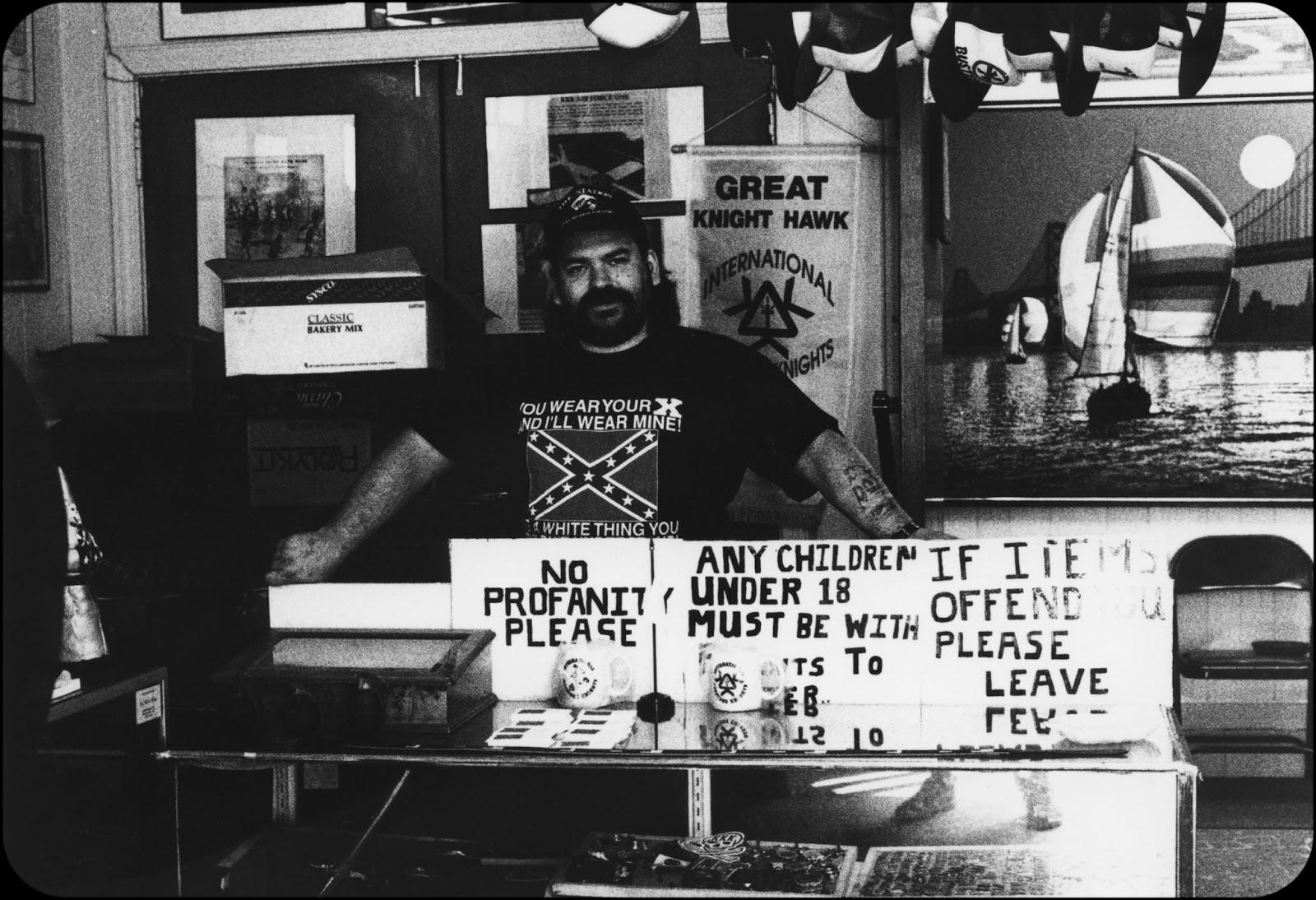
In recent years South Carolina has received national attention for its racial antagonisms, spurred by events such as the flying of the Confederate flag over the statehouse and church burnings.  Another chapter in the state's story of racial division began on March 1, 1996, when the Redneck Shop opened its doors in the town of Laurens.


Laurens is a town of 9,700 situated some 30 minutes southeast of Greenville. The store's proprietor is John Howard, who was an official in the Keystone Knights of the Ku Klux Klan. But Howard claims to be retired and says that the shop's purpose is to "teach people about the Klan, not spread bigotry."

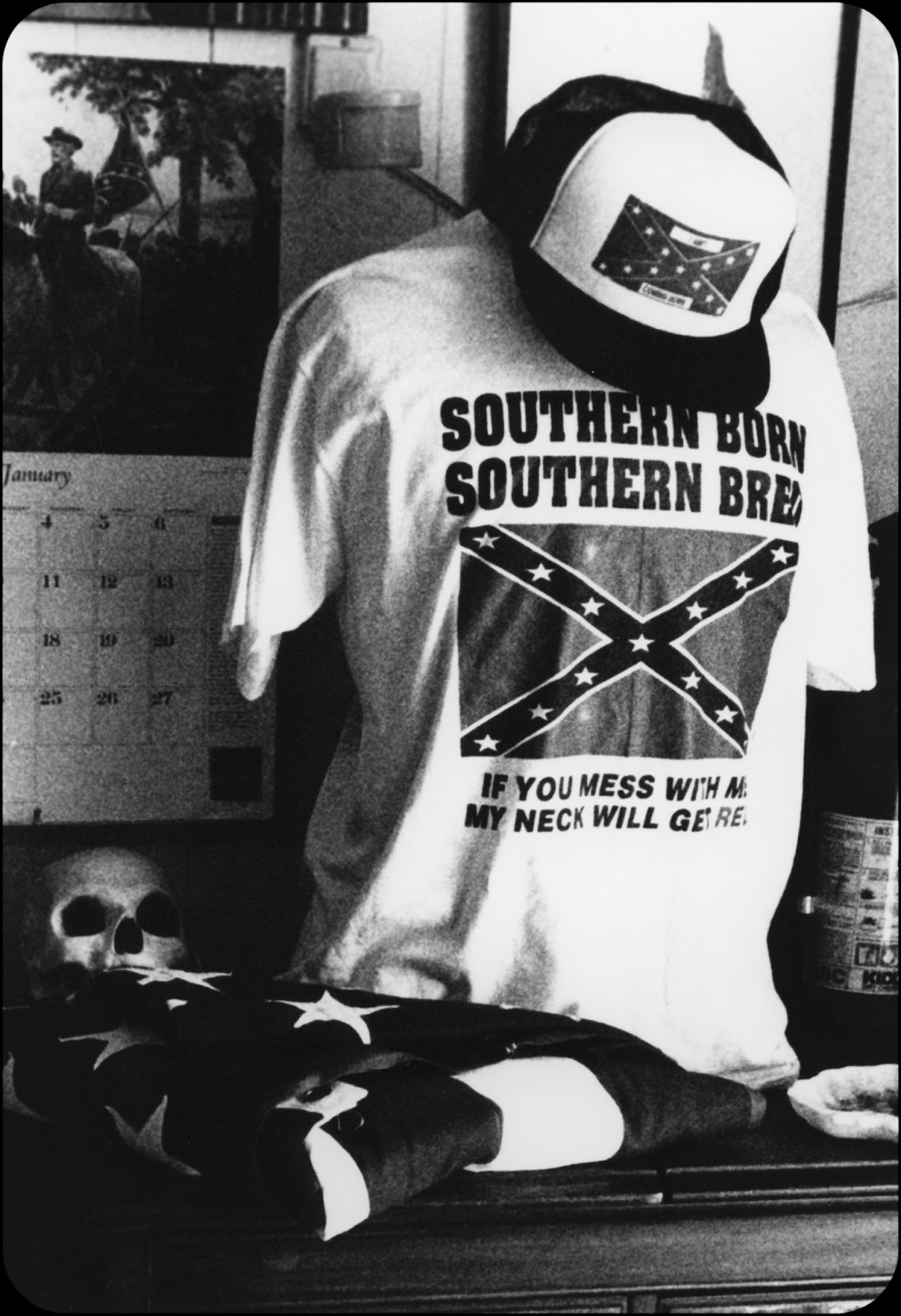
When you enter the Redneck Shop what you see are Klan robes, photographs, T-shirts and even skulls that clearly spread bigotry. I walked through the shop shortly after it opened, while over 300 people had gathered outside in protest. The spirit inside the Redneck Shop was smug and hateful, while the spirit of those gathered outside, both black and white, was loving and hopeful. Despite the public outrage, however, the store still operates today.


Wearing black and white ribbons, people gathered in March for the rally organized by Rev. David Kennedy, who is the pastor at the New Beginnings Baptist Missionary Church in Laurens.  One of those people was Becky McAllister, who said that "it makes me ashamed to say I was born and raised in South Carolina. I'm ashamed to be white. I want people to know that not all white southerners are racist."


Kennedy became involved because he wanted to stand with African American youth in Laurens who were extremely angry when the Redneck Shop opened its doors. Kennedy, who has photographs of Martin Luther King Jr. on his office walls, wanted to teach the possibilities of non-violent protest - a spirit that ran through the demonstration.

Over the last two years, there have been a number of smaller protests and national figures like Jesse Jackson have visited Laurens, but the Redneck Shop is still in business. Some local people - both black and white - say the shop is not just a museum, but a meeting place and recruiting ground for the Klan.

The two year history of the shop has not been uneventful and the past year's events can be described as peculiar. Howard has claimed that he has been persecuted and sued an African-American city councilman for defamation of character. On two occasions rocks were thrown through the store's window and a Columbia man drove his van through the shop's front door.  John Howard's son was jailed in May 1997 for spraying pepper gas in the faces of African American teenagers outside of the shop and then charged that he was beaten in the city jail. It was in the ealry summer of 1997, however, when events took a strange turn.


The building that housed the Redneck Shop, the old Echo Theater, was owned by Michael Burden, a John Howard protege and young member of the Klan. The store was actually Michael Burden's idea, and he legally gave Howard the right to operate the shop with no rent for as long as he lived. But Burden and Howard had a disagreement that led to Burden being unemployed and homeless. Burden, his new wife and her two children were living in the back of his truck.

Who did Burden end up asking for help? Rev. Kennedy. The minister fed Burden and his family and found them a place to live. A grateful Burden went to the pulpit of Kennedy's congregation and publicly thanked them, while expressing regret to the African American community: "I want to apologize for causing an eyesore on Laurens. At one point, I believed in this. But it was a wrong belief."

In appreciation to Kennedy and the church, Burden decided he wanted the church to have his building. Although Kennedy insisted Burden give it more thought, Burden was persistent and the church bought the old Echo Theater for $1,000 - making the African American church the new landlord of the Redneck Shop.

As if this irony is not enough, Burden is reportedly back at the shop. The story of the Redneck Shop is a peculiar one. But at essence it is about the ongoing battle between institutions of racism and those like Rev. Kennedy who lead us in the continuing fight for unity.


Friday, April 26, 2013

James Kantor’s A Healthy Grave – An Apartheid Prison Memoir Retro-Review


Nelson Mandela wrote of both his prison and Rivonia Trial experiences, as did Goven Mbeki.  Ruth First, Raymond Suttner, and Albie Sachs published prison diaries –117 Days, Inside Apartheid’s Prison, and The Jail Diary of Albie Sachs.  But A Healthy Grave was different.  Unlike Mandela, Mbeki, First, Suttner, or Sachs, James Kantor was not involved in the struggle.  The bottom line was that he was arrested for being the brother-in-law of Harold Wolpe.  Actually, he wasn’t alone in this type of detainment during the apartheid reign of the Nationalist Party.  Ronald First was arrested solely because he was the son of Julius and brother of Ruth.  But the story, of course, is much more complex.

James Kantor’s book was published in 1969.  A high-priced lawyer, Kantor was married to an actress/model when he was detained in 1963 by the apartheid regime.  He was not fond of communism and did not approve of the Marxist disposition of his brother-in-law, Harold Wolpe.  But he was Wolpe’s law partner and was jailed after Wolpe, Arthur Goldreich, Abdulhay Jasset, and Mosie Moolla escaped from Marshall Square prison in Johannesburg.  So why is this book still important.  First, of course, it is worthwhile solely because James Kantor’s prison/trial memoir needs to be read and reread as part of the history of apartheid – it is a book that appears to be lost for many South Africans.  But it is also important because it reemphasizes issues of liberty and democracy that are transgressed at the present time by the South African government and other nations throughout the world.

Kantor wrote of his experience from exile in London six years after the judge in the infamous Rivonia Trial, Quartus de Wet, dismissed his charges before sentencing eight of his co-defendants to life in prison.  But, dismissal did not come until Kantor was put through his own Kafkaesque version of hell in 1963.  Arrested at his office, shuffled between prisons in Johannesburg and Pretoria, given bail only to have it rescinded, James Kantor was still well aware that he was treated much better than any black detainees.  In spite of that awareness, the injustice of his experience provides multiple as well as wide-ranging lessons.  In addition, the apartheid regime ruined his life and arguably facilitated his early death.

There are a variety of insights and lessons from Kantor’s reflections.  He had a breakdown at one point of his sentence but understood fully that his detainment was relatively relaxed.  He lost his law practice and livelihood and yet, he was able to contemplate on his place in South African society.

I was no active do-gooder with a burning desire to right the wrongs of the world.  I felt I had contributed in a small way to racial tolerance by allowing the defense of political cases through the office at no cost to the accused; but, in the cold darkness, with my sandals slop-slopping on the concrete floor as I shambled my way up and down, I realized this was nothing more than a superficial sop to the conscience which was now struggling to break through the smugness engendered by years of good living.  At the same time I could not stop feeling sorry for myself.

Nelson Mandela, Hilda Bernstein, and his sister, AnnMarie Wolpe, all wrote about James Kantor in their respective autobiographies.  Mandela asserted that “he had no involvement whatsoever with the ANC or MK.”   “I assumed the only reason the state kept up the charade of prosecuting him in prison was to intimidate progressive lawyers,” added Madiba.  It is in AnnMarie’s book, however, that we get testimony of her brother’s lack of involvement in struggle politics or actions.  When she decided to tell him that Harold was planning an escape, his response was: “My God, he’s crazy.  He must stand his trial like a gentleman.”

Throughout the book Kantor gives thanks for the many people who assisted him throughout his detention and trial.  There were the lawyers that tried to help save his practice including Joel Joffe and liberal colleagues Jack Cooper, Ben Joseph, and Harry Schwartz.  The last was de Klerk’s appointment as Ambassador to the United States in 1990.  Kantor recalled thoughtful conversations with co-defendants Robert Hepple and Denis Goldberg as well as the strength of his wife Barbara.  But, the deepest memories in terms of ‘allies’ are of Nelson Mandela and Kantor’s own mother.  The culminating experience with Madiba came on the day de Wet ruled for Kantor’s release.

That morning, while waiting in the cell before the start of proceedings, Nelson and I had been walking up and down discussing my application.  He was very confident that it would succeed, and suddenly stopped in his tracks and said impulsively, ‘Here, let’s exchange ties for luck.’

Mandela also recalled the moment:

But when he saw the wide, old-fashioned tie I gave him compared to the lovely, silk tie he gave me, he probably thought I was merely trying to improve my wardrobe.  Jimmy was something of a clothehorse, but he wore the tie to court and when Justice de Wet dismissed the charges against him, he lifted the tie up to me as a kind of salute and farewell.

Kantor also wrote of his mother:

I was constantly amazed at the way my mother behaved.  She contrived to be always cheerful and full of hope, a remarkable feat for someone over sixty.  In the past year there had been the death of my father, the almost fatal illness of a grandchild, Harold Wolpe's arrest, the arrest and release of my sister, and then my arrest.  And yet she remained bright, full of confidence, and seemed younger than ever."

Two additional aspects of A Healthy Grave expose both the evil of apartheid and issues that are still evident today in terms of government, power, and citizenry.  Throughout the book we are presented portraits of the purveyors of apartheid.  In addition, Kantor’s internal deliberations on talking to the Special Branch, of ratting out other people, speak to the ethical/moral dilemma that existed at the time and remains today, not only in places like Palestine and Pakistan, but in South Africa and throughout the world.  Descriptions of Special Branch detectives Swanpoel and Viktor, as well as Rivonia Trial prosecutor, Percy Yutar, appear in James Kantor’s memoir.  While both Swanpoel and Viktor are portrayed in other prison diaries, and a mini-biography of Yutar is included in Glenn Frankel’s Rivonia’s Children, Kantor provides insights into how the dispositions and actions of all three men are directly related to the immorality of apartheid.  Almost everyone who has written of his or her arrest, interrogation, and imprisonment by the apartheid regime has mentioned Swanpoel.  Descriptions by Kantor connect to the overt examples of Special Branch obscenity that other people have described.

He is about thirty-five years old, of medium height but so broad as to create an illusion of stockiness.  He is already starting to turn fat.  His fair crew-cut hair bristles up on the crown of his head above a thick neck and squashed-up red, pugilistic face.  His most distinguishing features are tiny eyes… Over the years I had defended several cases in which he was the investigating officer, and almost without exception prisoners complained his violence.  He boasted openly of having shot and killed several Africans resisting arrest.


Kantor’s encounters with Viktor, a man who sparred with Ruth First during the latter stages of her imprisonment, exemplify the breadth of the apartheid ethos. There were two events and they both warrant full quotations.  The first ensued when Viktor transported Kantor to the prison in Pretoria.

Once outside of Johannesburg, Viktor started talking.  He spoke in English and, although he addressed his remarks to his companion, they were clearly meant for me.  The topic he chose for discussion was ‘The Jews’, on which he now professed to have a vast and specialized knowledge.  For instance, he knew for a fact and ‘even the Bible made it clear’ that there had never been any Jewish pioneers or explorers.  Their cunning was always to wait until a country had been fully colonized and then to move in and take over its wealth by dishonest means.  They were Communists and money-lenders, they were vermin, they should be exterminated and Hitler certainly knew what he was doing.  His companion seemed embarrassed and looked straight ahead without making any comments.  Finally, I broke into the monologue.  ‘You know, Vic, I’ve always known that you had no manners, but for the first time I realize that you are also stupid.  You are making a bloody idiot of yourself which I find quite amusing.’

The second occurrence was similar although circumstances had changed in that it was very clear that it was only a matter of time before charges would be dismissed.  On this occasion Viktor had driven James Kantor to his home at the time, Marshall Square Prison in Johannesburg.

Once more making derogatory remarks about the Jews.  He dealt with Jewish blood-sucking, Jewish business dishonesty, Jewish involvement in sabotage, adding that I should remember that the gallows were being oiled in preparation for me and my companions.  I kept quiet until we arrived at Marshall Square.  Once in the charge office, with all the staff within hearing distance, I said loudly, ‘You can now listen to me, Viktor.  You’re an ignorant bastard and I’ve had just about enough of your stupid anti-Jewish statements and impertinent behavior.  I intend making a full statement about this in Court tomorrow and I would now appreciate it if you would repeat what you said in the car, so that I have some more witnesses.’

Ironically, the third purveyor of apartheid whom Kantor described, the prosecutor, Percy Yutar, was Jewish.  While Yutar has been thoroughly described by other writers, Kantor’s portrait is interesting because he contrasts it with that of Heinrich de Villiers, who was a strident Nationalist Party member and judge.  In his book Rivonia, de Villiers wrote: “Yutar has been the undoing of many a reluctant or truculent witness.  One of the most respected and colourful in South Africa’s administration of justice.”  To which Kantor said:

Yutar is a little tyrant filled with his own importance and a burning desire to become the first Jewish Attorney General ever appointed in South Africa.  Of his Jewishness he makes no secret and professes to be devoutly religious.  In fact he asked to be assigned to the Rivonia Trial in order to vindicate the Jewish community in South Africa and to prove ‘that all Jews are not Communists’.

Finally, James Kantor was faced with an ethical dilemma as soon as he was arrested and throughout the time he was detained.  Shortly after Harold Wolpe escaped from Marshall Square, Hilda Bernstein visited Kantor at his office and asked for help hiding the escapees.  Kantor recalled the first interrogation and knew that if he implicated Bernstein or someone he does not name, Market Theatre impresario Barney Simon, he could have gone free.

The thought of going back into a cell was terrifying, and the alternative so simple.  In fact I need mention only one name.  But which one?  Either way, it meant someone being arrested that very night and so I would simply be trading my freedom for that of another.

Kantor did ponder whether or not he was being irresponsible toward his family obligations.  But at various times during interrogations he thought, “It was simply that if I exchanged my position with someone else, no matter who, I knew that I should regret it for the rest of my life.”  The Special Branch also attempted to get Kantor to snitch on his fellow prisoners, Rusty Bernstein, Robert Hepple, and Denis Goldberg.  Hilda Bernstein wrote about the issue in The World That Was Ours.

Jimmy knew Bob and Rusty very slightly, Denis not at all; none of them meant anything to him.  He was opposed to their political views and activities.  Yet again he refused to take the path of escape offered to him.  The temptation must have been enormous… to save what was left he was asked to do quite a simple thing; to turn his back on these men who, after all, meant nothing at all to him.  Yet he did not.

James Kantor did turn his back on the legal profession – an institution that he had total belief in but proved to him, in a very personal way, that it was a shameful sham in apartheid South Africa.  Not long after released from prison, he decided that he could no longer live in South Africa.  He moved to London with his family but he was a changed man.  And in 1974, at the age of forty-seven, his life was cut short by a heart attack.  In 1963, the apartheid regime was becoming increasingly vicious and their treatment of Kantor was a foreshadowing of the obscene treatment of other South Africans, activists and others, who were harassed, detained, and murdered by agents of the South African government.  Innocent people were killed in Sharpeville and Soweto while young liberals, draft resisters and United Democratic Front activists met the same fate for over two decades after James Kantor was arrested and tried for being Harold Wolpe’s brother-in-law.  Besides being an important historical story – let us also view Kantor’s story as a cautionary tale in South Africa and throughout the world.

Monday, April 15, 2013

Well Read Read – On Jay Naidoo on Chris Hani


On 10 April 1993, as he returned to his suburban Johannesburg home, South African freedom fighter Chris Hani was assassinated by an ultra-right extremist.  At the time, the negotiations to finalize the end of apartheid were nearing the finish line that would become the first South African democratic election in 1994.  Hani was a key leader in the African National Congress-South African Communist Party- Congress of South African Trade Unions trialliance.  In fact, during the exile struggle years with Nelson Mandela, Walter Sisulu, and Govan Mbeki imprisoned, Hani, along with Oliver Tambo and Joe Slovo, was arguably one of the three key leaders in the struggle against apartheid. Last week, Jay Naidoo, a struggle labor leader himself, connected Chris Hani to the present.  His essay is titled:


A culture of service and tolerance: Lessons from Chris Hani – Jay Naidoo

Twenty years on and it is sometimes convenient, or simply too easy, to forget the abyss of civil war from which our leaders drew us back and to speculate on what might have been had the ANC taken a harder line in the negotiation process that led to South Africa’s first democratic elections of 1994. We sometimes need reminding that the liberation movement achieved a “political miracle”. And we need to remind ourselves of the values held dear by Chris Hani, who represented the best of our patriots in wanting a meaningful democratic outcome for our people.

Twenty years have passed. What have we learnt from the ultimate sacrifice that Chris Hani made on that fateful day 20 years ago? I am reminded of a profound quote from an NGO I support, which says, “In every community, there is work to be done. In every nation, there are wounds to heal. In every heart, there is the power to do it."

The turbulent eighties, the era of our people’s defiance, saw the rise of the mass democratic movement led by the African National Congress. The Apartheid regime was in a structural crisis faced with a deepening economic catastrophe and a global illegitimacy, which forced a political stalemate in our country. Something had to give. The alternative was a racial civil war.

These were momentous times. It needed leaders of courage on both sides to rise above the conflict and see a path to a political settlement. But the release of Mandela and all political prisoners, the unbanning of the African National Congress, South African Communist Party and other banned organisations and the return of political exiles also saw a ferocious and brutal response by those right-wing forces opposed to democracy. Thousands of innocent black civilians paid the ultimate price as violence swept townships and people were murdered in their homes and slaughtered in the streets.

These were brutal times and fear stalked the land. It is convenient for some today to believe that these were not dangerous times and that we gave up too much in the negotiations process. In hindsight we did achieve a “political miracle”.

I reflect on some of the things that Chris Hani talked about and shared with me. He had decided that he would not go into Parliament although there was tremendous pressure on him. He was a communist and a democrat. He felt that power should also be built outside of government because of the political lessons he had learnt from other transitions.

Eight days before Comrade Chris was assassinated in April 1993, he was interviewed by social historian Luli Callinicos. In this interview, on the eve of the 1994 democratic election, he said that South Africa faced a “new enemy” and a “new struggle”.  That enemy, he said, was socio-economic; it was about the struggle for jobs, houses, schools, so that we can build a society that cares.
 
What Comrade Chris was calling for was a culture of service. A culture where nurses are guided by an ethic of care, teachers by an ethic of learning, police by an ethic of community safety, and local government by an ethic of service delivery. The new enemy, he said, was corruption and “we in the party have been discussing how we should cut down on salaries of ministers, of parliamentarians, so that if you are in Parliament in Cape Town, you actually rent a flat like everybody”. 

Importantly, he said in the interview that we must allow “the formation of many democratic formations  in this country, organs of civil  society, like the civics, independent trade unions, students’ organisations, teachers’ organisations, organisations of housewives , women, gays… so that we are kept reminded of the needs  of the people on the ground”.

He anticipated the major challenges we would experiences as a democracy when he said, “I think, finally, the ANC will have to fight a new enemy. That enemy would be another struggle to make freedom and democracy worthwhile to ordinary South Africans. Our biggest enemy would be what we do in the field of socio-economic restructuring; creation of jobs; building of houses, schools, medical facilities, overhauling our education, eliminating illiteracy, building a society which cares, and fighting corruption when power and government position enriches individuals.  We must build a different culture in this country, different from Africa, different from the Nationalist Party.  And that culture should be one of service to people.”

This is advice that we must all take to heart. The priority in education is the interests of the child, not the teachers, parents or government. In health it is the interests of the patient and, most importantly for our political and economic elites, it is the interests of the citizen.  When all of us take that into our hearts and our actions then we will have truly understood the wisdom of Chris Hani.

That was Jay Naidoo’s commemoration of Chris Hani.  It is important to emphasize Hani’s role in the struggle because his actions speak to the present.  Chris Hani not only spoke back to and fought the power of apartheid, but he spoke back to struggle leadership supporting his comrades – Chris Hani believed in democracy from the ground.

Speaking at Hani's funeral Joe Slovo said: “Chris Hani had a dream of democracy. They killed the man, but they can never kill the dream. And the dream Chris Hani had is about to become a reality.”  Jay Naidoo wants to see that dream come to further fruition – in South Africa and throughout the world.

For more on Chris Hani see Janet Smith and Beauregard Tromp’s book, Hani: A Life too Short.