Pages

Sunday, June 16, 2013

A Radical Line: From the Labor Movement to the Weather Underground, One Family’s Century of Conscience – A Retro-Review


Reading Neil Gordon’s novel and then viewing Robert Redford’s film, The Company You Keep, a fictitious portrayal of the Weather Underground Organization (WUO), led me to re-read Thai Jones’ book on his family – his mom and dad WUO people Eleanor Stein and Jeff Jones, as well as their parents, Albert Jones a Quaker and WWII conscientious objector and Annie and Arthur Stein, labor movement people and both members of the Communist Party.  While I actually liked Redford’s film and the book even more, A Radical Line is much more encompassing as it portrays generations and real lives in the continuing struggle for a democratic, socialist America – yes, Eleanor and Jeff and I think Thai, as well as many of their WUO comrades and their children, continue the fight today.

I had no intentions of writing a review as I began to re-read A Radical Line.  The story, though, is so engrossing, and Thai Jones’ combination of detail, thoughtfulness, and drama, pull you in as words bring depth to his extended family as well as collective, progressive struggle in the United States.  Jones’ craft as a writer combined with depth of story are poignant in the first two pages of the book as he describes his parents arrest through reflections of his own memories of the event as a four year old child.

There had to be something I could do to help my parents.  I made a fast survey of my possessions: a cowboy outfit, a coloring book, a stuffed Tyrannosaurus.  I opened the drawer of my little desk and picked up my child’s scissors.  The ends were rounded, and the blades were covered by blue plastic guards.  Bouncing them in my hand and snipping at the air, I considered putting on the cowboy hat and charging into the hallway with scissors blazing to defeat these men who had come to hurt our family.   Even then, I knew it was a battle against long odds.  But I didn’t realize it was a question that many in my family had already faced.  They had chosen to fight.

Throughout A Radical Line the progressive fights of Thai Jones’ extended families, WUO and earlier, are connected to the collective struggle against class disparity, racism, and the Viet Nam War.  Jeff Jones was raised in southern California and his father worked for Walt Disney Corporation.  But as already noted, Albert Jones was a pacifist, and his experience working as a conscientious objector at Civilian Public Service Camp #37 in Coleville, California during WWII is itself a story.  His path was not easy as his father disapproved and church people at the Methodist congregation that nurtured his views abandoned him – Camp #37 became home: “He was surrounded by pacifists.  Each Sunday they held a silent Quaker meeting, and that was the only time in the week that the men were not in heated discussions about their faith.  Coming here, Albert finally felt welcome.”

Jeff Jones’ early lessons were pacifism and peace and not a long leap to the civil rights movement and opposing the Viet Nam War.

Eleanor Stein’s parents were much more political.  Annie was introduced to socialism in high school and was politicized even further as a student at Hunter College.  Thai Jones describes her early participation in the National Student League and the communist party.  It was Annie who politicized Arthur.  Initially she was disheartened because her husband was apolitical, but she began leaving copies of The Daily Worker around their apartment and soon Arthur was attending meetings and demonstrations.

Like Albert Jones’s life-long commitment to non-violence, Annie and Arthur Stein never stopped fighting class disparity and racism.  While Thai Jones is much more descriptive on their lives than I can be in this short review, it is his description of their lives, including Albert’s assertion to Jeff before the Days of Rage: “Son, I believe very strongly in your goals.  But if you set out to hurt somebody, I would hope and pray that you are hurt first.” Concurrently, Eleanor was clearly nurtured by Annie’s work with civil rights stalwart Mary Church Terrell and her political work on education in NYC.  She was also nurtured by her father’s labor activism, his founding of the Fair Play for Cuba Committee chapter in Brooklyn, and his appearance before the HUAC where he was represented by Victor Rabinowitz, the attorney who also represented Paul Robeson and Pete Seeger.  Annie and Arthur sent Eleanor to Camp Lakeside, a Red Diaper summer camp.  Eleanor recalled her mother’s expulsion from the CP over China and mother continued to lecture daughter throughout Eleanor’s WUO years:

“Look,” Annie would tell Eleanor, “I lived through the 1930s when the capitalist system was on the ropes.  Labor unions were strong and men were out of work, on breadlines.”  Pausing for effect, she would light a cigarette, sip her scotch and soda, and go to the bookshelf for her copy of Lenin’s What Is to Be Done?  It was obvious in 1917,” she would say, waving the book in her daughter’s face.  “The workers were in the streets.  Who is going t0 run the means of production in your revolution?  The hippies? You’ve got to be kidding.”

The heart of A Radical Line, however, is Jeff and Eleanor’s lives in SDS and the Weather Underground and their coming together as a couple.  There are rich photographs in the center of the book – especially one of Eleanor wearing her lamb’s wool jacket with a raised fist salute in front of Columbia University Law School.  Most endearing is a page with portraits of both Thai, as a very young child, and Jeff in running gear.  We learn about Eleanor quitting law school after participating in the Columbia University student takeover in 1968 and of Jeff joining SDS while a student at Antioch.  There are other events that have been written about by Mark Rudd, Cathy Wilkerson, Bill Ayers, and others; but Thai Jones presents a different take, new insights, and of course issues that still leave us with questions about WUO and the struggle in general.  We learn a great deal about WUO life underground but for the purpose of this review I would like to address one particular issue.

It begins in early July 1969, when Eleanor was part of delegation that went to Cuba to meet with representatives of the National Liberation Front and North Vietnamese government.  Others on the trip included Bernardine Dohrn and Diana Oughton.  The North Vietnamese had invited Eleanor and her comrades so that they could interact and learn how the anti-war movement in the United States might help to end the War.  One of the first lessons was on the lack of focus of American activism.  The teacher pointed out that day that anti-war slogans and chants:

     No Move Vietnams v. Two, Three, Many Vietnams
     No More Wars v Bring the War Home
     Long Live the Victory of the People’s War v. Make Love not War

were contradictory – what was the goal?

The Americans traveled Cuba with their Vietnamese mentors and one man, Nguyen Thai stood out – the man from who Thai Jones inherited his name.  There were hours and hours of discussions and Eleanor and the other Americans became focused on taking one message to the masses back home – “End the War Now.”

When they returned to the U.S., however, they were informed that their leadership had decided to form small collectives – their job was not to organize the masses.  Thai Jones writes, “Before Eleanor had even clanked down the gangway to the shore, Nguyen Thai’s plan for an all-encompassing mass movement was sunk.”

And I would argue, that it was at this point, before the forming of the Weather Underground, before the Townhouse Bombing, before the manifestos and armed propaganda, before freeing and then being betrayed by Timothy Leary, and before the break-up of WUO, the youth movement for social justice & equality in the United States was doomed.  That is, doomed as a movement.  While the Vietnamese represented and spoke of a people’s movement, people on the ground weren’t included in the United States.  The people of WUO and the anti-war movement in general were young – we didn’t take the lessons that others taught us.  We didn’t pay attention to how different Fidel and Che’s revolution in Cuba was to Che’s adventurist foray into Bolivia – we didn’t know how to organize a people’s war.

My analysis, of course, is only a small part of Thai Jones’s book.  And the people that he writes about, particularly his parents Eleanor Stein and Jeff Jones, as well as their WUO comrades, have continued, maybe not as a movement, but nevertheless continued, the fight to end class disparity and racism in the United States and throughout the World.  Their mistakes as well as their continuing commitment and passion offer important lessons.  As does Thai Jones’ book, A Radical Line.


Saturday, May 18, 2013

The Rivonia Raid – 50 Year Commemoration


In the early 1960s the South African government upped the ante with both physical and psychological oppression of black people and others who challenged the apartheid regime.  At the time two prominent anti-apartheid organizations, the African National Congress and the outlawed South African Communist Party made a joint decision to begin armed resistance – bombing government facilities but making sure that there were no people at the sites that were bombed.  The plan was called Operation Mayibuye and under the auspices of the newly formed MK, led by Nelson Mandela of the ANC and Joe Slovo SACP, there were numerous small scale bombings. The government fought back, of course, with all of its power and the culminating event at the time was the raid on Lilliesleaf Farm – referred to as the Rivonia Raid.

The South African Communist Party bought Lilliesleaf Farm as an operational base to fight the South African apartheid government. Nelson Mandela explained at the time that the decision corresponded to the violent oppression of the apartheid regime in reaction to peaceful dissent.

Listen to Nelson Mandela 1:25-1:52 at


But this was not an easily taken decision and some leaders in both the African National Congress and Communist Party, like Walter Sisulu and Rusty Bernstein, were dissenters. Reflecting on the time, Raymond Suttner, who was imprisoned during apartheid for fighting the South African government, explained the difficulty of the decision.

Listen to Raymond Suttner 2:07-2:48 at


While original actions, as already noted, were attacks on targets like electrical pylons and other unpeopled communication sites, Operation Mayibuye plans were much greater and called for transition from non-violent protest to guerilla warfare. In reality, the South African government, to paraphrase the black panthers, had bigger bombs and bigger guns.  Lilliesleaf Farm had become the center for operationalizing Mayibuye and ANC leaders like Mandela and Sisulu were often underground on the farm while other comrades were in and out.  By the time of the raid in July 1963, Nelson Mandela was already in prison, and key ANC and SACP leaders like Oliver Tambo and Joe Slovo were in exile trying to convince newly de-colonized African nations to support the armed struggle.  Struggle leaders continued to meet at Lilliesleaf but they were aware of the fact that the government was closing in.  In fact, Denis Goldberg, who would be arrested in the raid, reflected on the meeting on that fateful day.

Listen to Denis Goldberg 0:00-0.44 at


When the government struck on July 11, 1963 they, in their own words, “stumbled upon the heart of the opposition leadership.” They were expecting to find Walter Sisulu, and that in itself would have been an exceptional victory, but they were elated when they realized that Govan Mbeki, Rusty Bernstein, Ahmed Kathrada, Denis Goldberg and other struggle leaders were also at the house. There had been a tip about Sisulu and there has always been speculation that the CIA was the tipster just as American Empire spies had been in the arrest of Mandela earlier in the year.  Arthur Goldreich, the nominal owner of Lillisleaf, came home during the raid – he recalls the arrest.

Listen to Arthur Goldreich 1:17-1:35 at


Other activists were arrested and along with Mandela and the 8 people at the farm were charged with sabotage.  The trial was called the Rivonia Trial and Glenn Frankel has written a thorough and thoughtful account in his book Rivonia’s Children.  While the trial in itself was a circus with a showboating prosecutor and steadfast, serious, and resolute defendants, both the lawyers for Mandela and his comrades, as well as the defendants themselves, expected the death penalty as the evidence collected at Lilliesleaf Farm clearly showed that they were revolutionaries.  Mandela spoke to the court and while there had been different legal strategies for each of the defendants, they all joined the future President who said:

Listen to Nelson Mandela 3:56-4:14 at


The verdict came on June 11, 1964 and much to everyone’s surprise the sentence was life in prison – not death.  However, government oppression grew even worse and with leaders either imprisoned or in exile, the fledgling struggle, to use a boxing metaphor, was at best on the ropes. Although never dead, opposition really did not ignite again until the mid-seventies and the Soweto Uprising. The armed struggle grew throughout the eighties and as everyone knows Nelson Mandela was elected as South Africa’s first democratic president in 1994.  To talk about the end of apartheid as a miracle and South Africa as a rainbow nation is not incorrect.  But as a nation state, it today acts corporately and non-democratically just as we do in the United States. South Africans, just as everyone else in the world, need to take lessons from the sacrifices of the people who fought to end apartheid.


Saturday, May 11, 2013

The Red Neck Shop

(This was first published in the Spring 1998 issue of Southern Exposure)

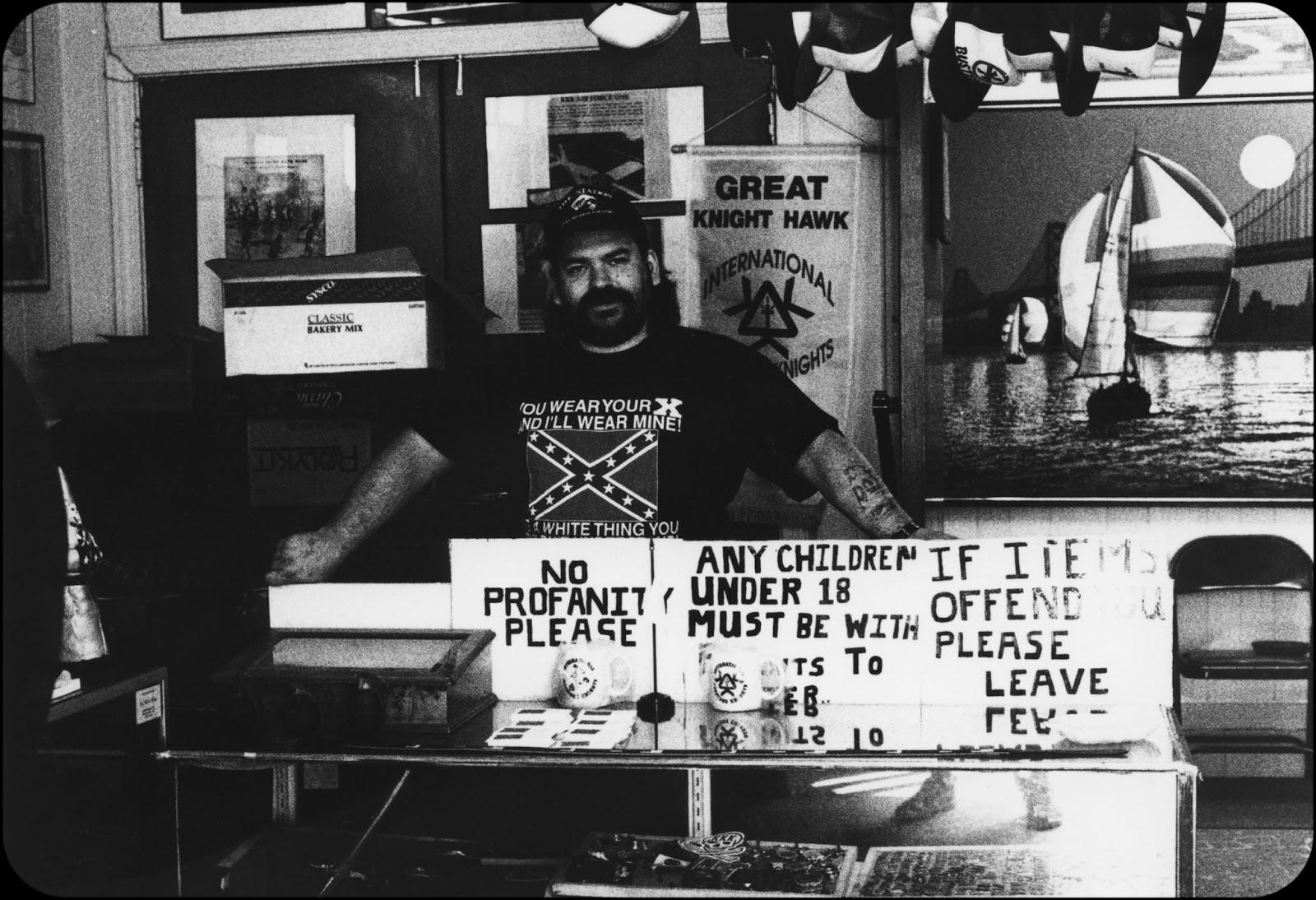
In recent years South Carolina has received national attention for its racial antagonisms, spurred by events such as the flying of the Confederate flag over the statehouse and church burnings.  Another chapter in the state's story of racial division began on March 1, 1996, when the Redneck Shop opened its doors in the town of Laurens.


Laurens is a town of 9,700 situated some 30 minutes southeast of Greenville. The store's proprietor is John Howard, who was an official in the Keystone Knights of the Ku Klux Klan. But Howard claims to be retired and says that the shop's purpose is to "teach people about the Klan, not spread bigotry."

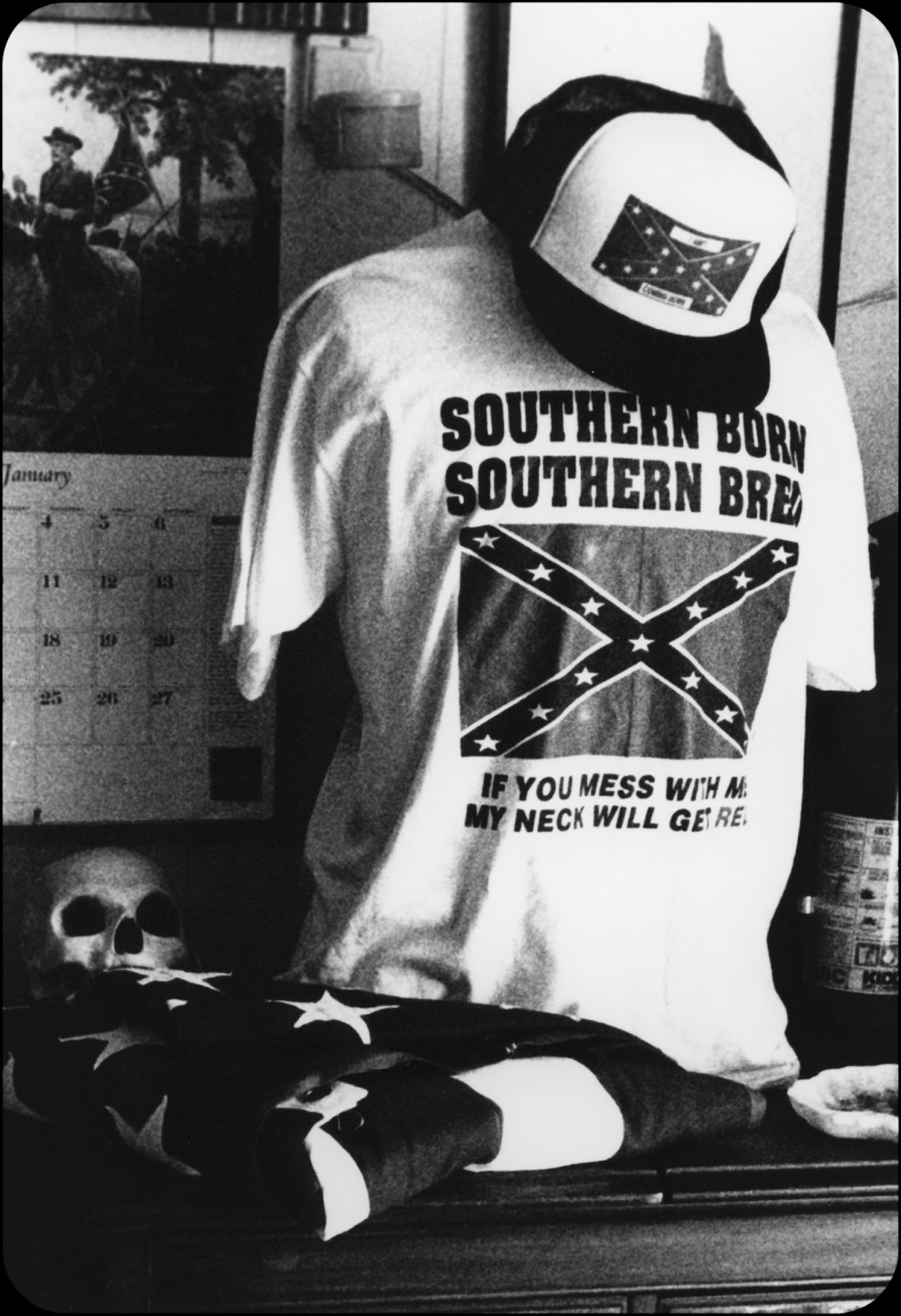
When you enter the Redneck Shop what you see are Klan robes, photographs, T-shirts and even skulls that clearly spread bigotry. I walked through the shop shortly after it opened, while over 300 people had gathered outside in protest. The spirit inside the Redneck Shop was smug and hateful, while the spirit of those gathered outside, both black and white, was loving and hopeful. Despite the public outrage, however, the store still operates today.


Wearing black and white ribbons, people gathered in March for the rally organized by Rev. David Kennedy, who is the pastor at the New Beginnings Baptist Missionary Church in Laurens.  One of those people was Becky McAllister, who said that "it makes me ashamed to say I was born and raised in South Carolina. I'm ashamed to be white. I want people to know that not all white southerners are racist."


Kennedy became involved because he wanted to stand with African American youth in Laurens who were extremely angry when the Redneck Shop opened its doors. Kennedy, who has photographs of Martin Luther King Jr. on his office walls, wanted to teach the possibilities of non-violent protest - a spirit that ran through the demonstration.

Over the last two years, there have been a number of smaller protests and national figures like Jesse Jackson have visited Laurens, but the Redneck Shop is still in business. Some local people - both black and white - say the shop is not just a museum, but a meeting place and recruiting ground for the Klan.

The two year history of the shop has not been uneventful and the past year's events can be described as peculiar. Howard has claimed that he has been persecuted and sued an African-American city councilman for defamation of character. On two occasions rocks were thrown through the store's window and a Columbia man drove his van through the shop's front door.  John Howard's son was jailed in May 1997 for spraying pepper gas in the faces of African American teenagers outside of the shop and then charged that he was beaten in the city jail. It was in the ealry summer of 1997, however, when events took a strange turn.


The building that housed the Redneck Shop, the old Echo Theater, was owned by Michael Burden, a John Howard protege and young member of the Klan. The store was actually Michael Burden's idea, and he legally gave Howard the right to operate the shop with no rent for as long as he lived. But Burden and Howard had a disagreement that led to Burden being unemployed and homeless. Burden, his new wife and her two children were living in the back of his truck.

Who did Burden end up asking for help? Rev. Kennedy. The minister fed Burden and his family and found them a place to live. A grateful Burden went to the pulpit of Kennedy's congregation and publicly thanked them, while expressing regret to the African American community: "I want to apologize for causing an eyesore on Laurens. At one point, I believed in this. But it was a wrong belief."

In appreciation to Kennedy and the church, Burden decided he wanted the church to have his building. Although Kennedy insisted Burden give it more thought, Burden was persistent and the church bought the old Echo Theater for $1,000 - making the African American church the new landlord of the Redneck Shop.

As if this irony is not enough, Burden is reportedly back at the shop. The story of the Redneck Shop is a peculiar one. But at essence it is about the ongoing battle between institutions of racism and those like Rev. Kennedy who lead us in the continuing fight for unity.


Friday, April 26, 2013

James Kantor’s A Healthy Grave – An Apartheid Prison Memoir Retro-Review


Nelson Mandela wrote of both his prison and Rivonia Trial experiences, as did Goven Mbeki.  Ruth First, Raymond Suttner, and Albie Sachs published prison diaries –117 Days, Inside Apartheid’s Prison, and The Jail Diary of Albie Sachs.  But A Healthy Grave was different.  Unlike Mandela, Mbeki, First, Suttner, or Sachs, James Kantor was not involved in the struggle.  The bottom line was that he was arrested for being the brother-in-law of Harold Wolpe.  Actually, he wasn’t alone in this type of detainment during the apartheid reign of the Nationalist Party.  Ronald First was arrested solely because he was the son of Julius and brother of Ruth.  But the story, of course, is much more complex.

James Kantor’s book was published in 1969.  A high-priced lawyer, Kantor was married to an actress/model when he was detained in 1963 by the apartheid regime.  He was not fond of communism and did not approve of the Marxist disposition of his brother-in-law, Harold Wolpe.  But he was Wolpe’s law partner and was jailed after Wolpe, Arthur Goldreich, Abdulhay Jasset, and Mosie Moolla escaped from Marshall Square prison in Johannesburg.  So why is this book still important.  First, of course, it is worthwhile solely because James Kantor’s prison/trial memoir needs to be read and reread as part of the history of apartheid – it is a book that appears to be lost for many South Africans.  But it is also important because it reemphasizes issues of liberty and democracy that are transgressed at the present time by the South African government and other nations throughout the world.

Kantor wrote of his experience from exile in London six years after the judge in the infamous Rivonia Trial, Quartus de Wet, dismissed his charges before sentencing eight of his co-defendants to life in prison.  But, dismissal did not come until Kantor was put through his own Kafkaesque version of hell in 1963.  Arrested at his office, shuffled between prisons in Johannesburg and Pretoria, given bail only to have it rescinded, James Kantor was still well aware that he was treated much better than any black detainees.  In spite of that awareness, the injustice of his experience provides multiple as well as wide-ranging lessons.  In addition, the apartheid regime ruined his life and arguably facilitated his early death.

There are a variety of insights and lessons from Kantor’s reflections.  He had a breakdown at one point of his sentence but understood fully that his detainment was relatively relaxed.  He lost his law practice and livelihood and yet, he was able to contemplate on his place in South African society.

I was no active do-gooder with a burning desire to right the wrongs of the world.  I felt I had contributed in a small way to racial tolerance by allowing the defense of political cases through the office at no cost to the accused; but, in the cold darkness, with my sandals slop-slopping on the concrete floor as I shambled my way up and down, I realized this was nothing more than a superficial sop to the conscience which was now struggling to break through the smugness engendered by years of good living.  At the same time I could not stop feeling sorry for myself.

Nelson Mandela, Hilda Bernstein, and his sister, AnnMarie Wolpe, all wrote about James Kantor in their respective autobiographies.  Mandela asserted that “he had no involvement whatsoever with the ANC or MK.”   “I assumed the only reason the state kept up the charade of prosecuting him in prison was to intimidate progressive lawyers,” added Madiba.  It is in AnnMarie’s book, however, that we get testimony of her brother’s lack of involvement in struggle politics or actions.  When she decided to tell him that Harold was planning an escape, his response was: “My God, he’s crazy.  He must stand his trial like a gentleman.”

Throughout the book Kantor gives thanks for the many people who assisted him throughout his detention and trial.  There were the lawyers that tried to help save his practice including Joel Joffe and liberal colleagues Jack Cooper, Ben Joseph, and Harry Schwartz.  The last was de Klerk’s appointment as Ambassador to the United States in 1990.  Kantor recalled thoughtful conversations with co-defendants Robert Hepple and Denis Goldberg as well as the strength of his wife Barbara.  But, the deepest memories in terms of ‘allies’ are of Nelson Mandela and Kantor’s own mother.  The culminating experience with Madiba came on the day de Wet ruled for Kantor’s release.

That morning, while waiting in the cell before the start of proceedings, Nelson and I had been walking up and down discussing my application.  He was very confident that it would succeed, and suddenly stopped in his tracks and said impulsively, ‘Here, let’s exchange ties for luck.’

Mandela also recalled the moment:

But when he saw the wide, old-fashioned tie I gave him compared to the lovely, silk tie he gave me, he probably thought I was merely trying to improve my wardrobe.  Jimmy was something of a clothehorse, but he wore the tie to court and when Justice de Wet dismissed the charges against him, he lifted the tie up to me as a kind of salute and farewell.

Kantor also wrote of his mother:

I was constantly amazed at the way my mother behaved.  She contrived to be always cheerful and full of hope, a remarkable feat for someone over sixty.  In the past year there had been the death of my father, the almost fatal illness of a grandchild, Harold Wolpe's arrest, the arrest and release of my sister, and then my arrest.  And yet she remained bright, full of confidence, and seemed younger than ever."

Two additional aspects of A Healthy Grave expose both the evil of apartheid and issues that are still evident today in terms of government, power, and citizenry.  Throughout the book we are presented portraits of the purveyors of apartheid.  In addition, Kantor’s internal deliberations on talking to the Special Branch, of ratting out other people, speak to the ethical/moral dilemma that existed at the time and remains today, not only in places like Palestine and Pakistan, but in South Africa and throughout the world.  Descriptions of Special Branch detectives Swanpoel and Viktor, as well as Rivonia Trial prosecutor, Percy Yutar, appear in James Kantor’s memoir.  While both Swanpoel and Viktor are portrayed in other prison diaries, and a mini-biography of Yutar is included in Glenn Frankel’s Rivonia’s Children, Kantor provides insights into how the dispositions and actions of all three men are directly related to the immorality of apartheid.  Almost everyone who has written of his or her arrest, interrogation, and imprisonment by the apartheid regime has mentioned Swanpoel.  Descriptions by Kantor connect to the overt examples of Special Branch obscenity that other people have described.

He is about thirty-five years old, of medium height but so broad as to create an illusion of stockiness.  He is already starting to turn fat.  His fair crew-cut hair bristles up on the crown of his head above a thick neck and squashed-up red, pugilistic face.  His most distinguishing features are tiny eyes… Over the years I had defended several cases in which he was the investigating officer, and almost without exception prisoners complained his violence.  He boasted openly of having shot and killed several Africans resisting arrest.


Kantor’s encounters with Viktor, a man who sparred with Ruth First during the latter stages of her imprisonment, exemplify the breadth of the apartheid ethos. There were two events and they both warrant full quotations.  The first ensued when Viktor transported Kantor to the prison in Pretoria.

Once outside of Johannesburg, Viktor started talking.  He spoke in English and, although he addressed his remarks to his companion, they were clearly meant for me.  The topic he chose for discussion was ‘The Jews’, on which he now professed to have a vast and specialized knowledge.  For instance, he knew for a fact and ‘even the Bible made it clear’ that there had never been any Jewish pioneers or explorers.  Their cunning was always to wait until a country had been fully colonized and then to move in and take over its wealth by dishonest means.  They were Communists and money-lenders, they were vermin, they should be exterminated and Hitler certainly knew what he was doing.  His companion seemed embarrassed and looked straight ahead without making any comments.  Finally, I broke into the monologue.  ‘You know, Vic, I’ve always known that you had no manners, but for the first time I realize that you are also stupid.  You are making a bloody idiot of yourself which I find quite amusing.’

The second occurrence was similar although circumstances had changed in that it was very clear that it was only a matter of time before charges would be dismissed.  On this occasion Viktor had driven James Kantor to his home at the time, Marshall Square Prison in Johannesburg.

Once more making derogatory remarks about the Jews.  He dealt with Jewish blood-sucking, Jewish business dishonesty, Jewish involvement in sabotage, adding that I should remember that the gallows were being oiled in preparation for me and my companions.  I kept quiet until we arrived at Marshall Square.  Once in the charge office, with all the staff within hearing distance, I said loudly, ‘You can now listen to me, Viktor.  You’re an ignorant bastard and I’ve had just about enough of your stupid anti-Jewish statements and impertinent behavior.  I intend making a full statement about this in Court tomorrow and I would now appreciate it if you would repeat what you said in the car, so that I have some more witnesses.’

Ironically, the third purveyor of apartheid whom Kantor described, the prosecutor, Percy Yutar, was Jewish.  While Yutar has been thoroughly described by other writers, Kantor’s portrait is interesting because he contrasts it with that of Heinrich de Villiers, who was a strident Nationalist Party member and judge.  In his book Rivonia, de Villiers wrote: “Yutar has been the undoing of many a reluctant or truculent witness.  One of the most respected and colourful in South Africa’s administration of justice.”  To which Kantor said:

Yutar is a little tyrant filled with his own importance and a burning desire to become the first Jewish Attorney General ever appointed in South Africa.  Of his Jewishness he makes no secret and professes to be devoutly religious.  In fact he asked to be assigned to the Rivonia Trial in order to vindicate the Jewish community in South Africa and to prove ‘that all Jews are not Communists’.

Finally, James Kantor was faced with an ethical dilemma as soon as he was arrested and throughout the time he was detained.  Shortly after Harold Wolpe escaped from Marshall Square, Hilda Bernstein visited Kantor at his office and asked for help hiding the escapees.  Kantor recalled the first interrogation and knew that if he implicated Bernstein or someone he does not name, Market Theatre impresario Barney Simon, he could have gone free.

The thought of going back into a cell was terrifying, and the alternative so simple.  In fact I need mention only one name.  But which one?  Either way, it meant someone being arrested that very night and so I would simply be trading my freedom for that of another.

Kantor did ponder whether or not he was being irresponsible toward his family obligations.  But at various times during interrogations he thought, “It was simply that if I exchanged my position with someone else, no matter who, I knew that I should regret it for the rest of my life.”  The Special Branch also attempted to get Kantor to snitch on his fellow prisoners, Rusty Bernstein, Robert Hepple, and Denis Goldberg.  Hilda Bernstein wrote about the issue in The World That Was Ours.

Jimmy knew Bob and Rusty very slightly, Denis not at all; none of them meant anything to him.  He was opposed to their political views and activities.  Yet again he refused to take the path of escape offered to him.  The temptation must have been enormous… to save what was left he was asked to do quite a simple thing; to turn his back on these men who, after all, meant nothing at all to him.  Yet he did not.

James Kantor did turn his back on the legal profession – an institution that he had total belief in but proved to him, in a very personal way, that it was a shameful sham in apartheid South Africa.  Not long after released from prison, he decided that he could no longer live in South Africa.  He moved to London with his family but he was a changed man.  And in 1974, at the age of forty-seven, his life was cut short by a heart attack.  In 1963, the apartheid regime was becoming increasingly vicious and their treatment of Kantor was a foreshadowing of the obscene treatment of other South Africans, activists and others, who were harassed, detained, and murdered by agents of the South African government.  Innocent people were killed in Sharpeville and Soweto while young liberals, draft resisters and United Democratic Front activists met the same fate for over two decades after James Kantor was arrested and tried for being Harold Wolpe’s brother-in-law.  Besides being an important historical story – let us also view Kantor’s story as a cautionary tale in South Africa and throughout the world.

Monday, April 15, 2013

Well Read Read – On Jay Naidoo on Chris Hani


On 10 April 1993, as he returned to his suburban Johannesburg home, South African freedom fighter Chris Hani was assassinated by an ultra-right extremist.  At the time, the negotiations to finalize the end of apartheid were nearing the finish line that would become the first South African democratic election in 1994.  Hani was a key leader in the African National Congress-South African Communist Party- Congress of South African Trade Unions trialliance.  In fact, during the exile struggle years with Nelson Mandela, Walter Sisulu, and Govan Mbeki imprisoned, Hani, along with Oliver Tambo and Joe Slovo, was arguably one of the three key leaders in the struggle against apartheid. Last week, Jay Naidoo, a struggle labor leader himself, connected Chris Hani to the present.  His essay is titled:


A culture of service and tolerance: Lessons from Chris Hani – Jay Naidoo

Twenty years on and it is sometimes convenient, or simply too easy, to forget the abyss of civil war from which our leaders drew us back and to speculate on what might have been had the ANC taken a harder line in the negotiation process that led to South Africa’s first democratic elections of 1994. We sometimes need reminding that the liberation movement achieved a “political miracle”. And we need to remind ourselves of the values held dear by Chris Hani, who represented the best of our patriots in wanting a meaningful democratic outcome for our people.

Twenty years have passed. What have we learnt from the ultimate sacrifice that Chris Hani made on that fateful day 20 years ago? I am reminded of a profound quote from an NGO I support, which says, “In every community, there is work to be done. In every nation, there are wounds to heal. In every heart, there is the power to do it."

The turbulent eighties, the era of our people’s defiance, saw the rise of the mass democratic movement led by the African National Congress. The Apartheid regime was in a structural crisis faced with a deepening economic catastrophe and a global illegitimacy, which forced a political stalemate in our country. Something had to give. The alternative was a racial civil war.

These were momentous times. It needed leaders of courage on both sides to rise above the conflict and see a path to a political settlement. But the release of Mandela and all political prisoners, the unbanning of the African National Congress, South African Communist Party and other banned organisations and the return of political exiles also saw a ferocious and brutal response by those right-wing forces opposed to democracy. Thousands of innocent black civilians paid the ultimate price as violence swept townships and people were murdered in their homes and slaughtered in the streets.

These were brutal times and fear stalked the land. It is convenient for some today to believe that these were not dangerous times and that we gave up too much in the negotiations process. In hindsight we did achieve a “political miracle”.

I reflect on some of the things that Chris Hani talked about and shared with me. He had decided that he would not go into Parliament although there was tremendous pressure on him. He was a communist and a democrat. He felt that power should also be built outside of government because of the political lessons he had learnt from other transitions.

Eight days before Comrade Chris was assassinated in April 1993, he was interviewed by social historian Luli Callinicos. In this interview, on the eve of the 1994 democratic election, he said that South Africa faced a “new enemy” and a “new struggle”.  That enemy, he said, was socio-economic; it was about the struggle for jobs, houses, schools, so that we can build a society that cares.
 
What Comrade Chris was calling for was a culture of service. A culture where nurses are guided by an ethic of care, teachers by an ethic of learning, police by an ethic of community safety, and local government by an ethic of service delivery. The new enemy, he said, was corruption and “we in the party have been discussing how we should cut down on salaries of ministers, of parliamentarians, so that if you are in Parliament in Cape Town, you actually rent a flat like everybody”. 

Importantly, he said in the interview that we must allow “the formation of many democratic formations  in this country, organs of civil  society, like the civics, independent trade unions, students’ organisations, teachers’ organisations, organisations of housewives , women, gays… so that we are kept reminded of the needs  of the people on the ground”.

He anticipated the major challenges we would experiences as a democracy when he said, “I think, finally, the ANC will have to fight a new enemy. That enemy would be another struggle to make freedom and democracy worthwhile to ordinary South Africans. Our biggest enemy would be what we do in the field of socio-economic restructuring; creation of jobs; building of houses, schools, medical facilities, overhauling our education, eliminating illiteracy, building a society which cares, and fighting corruption when power and government position enriches individuals.  We must build a different culture in this country, different from Africa, different from the Nationalist Party.  And that culture should be one of service to people.”

This is advice that we must all take to heart. The priority in education is the interests of the child, not the teachers, parents or government. In health it is the interests of the patient and, most importantly for our political and economic elites, it is the interests of the citizen.  When all of us take that into our hearts and our actions then we will have truly understood the wisdom of Chris Hani.

That was Jay Naidoo’s commemoration of Chris Hani.  It is important to emphasize Hani’s role in the struggle because his actions speak to the present.  Chris Hani not only spoke back to and fought the power of apartheid, but he spoke back to struggle leadership supporting his comrades – Chris Hani believed in democracy from the ground.

Speaking at Hani's funeral Joe Slovo said: “Chris Hani had a dream of democracy. They killed the man, but they can never kill the dream. And the dream Chris Hani had is about to become a reality.”  Jay Naidoo wants to see that dream come to further fruition – in South Africa and throughout the world.

For more on Chris Hani see Janet Smith and Beauregard Tromp’s book, Hani: A Life too Short.

Friday, March 22, 2013

David Grossman's The Yellow Wind - A Retro-Review


David Grossman’s The Yellow Wind – A Retro-Review[1]

David Grossman did the interviews for his book, The Yellow Wind, in May 1987, six months before the first Intifada.  Not only did the book show that particular decade’s oppressive reality of Israel toward Palestine, it illustrated the causes of that Intifada, and sadly, the one that followed and those that will come because of Israel’s continuing oppression that is now wed with expanding settlements on Palestinian land in what is at the very least the closest, present parallel to the Bantustan states in apartheid South Africa.  Although somewhat confounding, Grossman did not himself define Israel as the oppressor and Palestine as the oppressed.  “Defining Israel’s position as wrong in principle and the Palestinian position as entirely righteous, is simplistic and false,” he said.  Grossman’s book is compelling, however, because he relies on the voices of “ordinary” Palestinians and Israelis, not politicians or officials, living in the West Bank at the time.  And the people that he spoke with clearly do signify – the oppressor and the oppressed.

The fact is that when I wrote the book I had no intention of suggesting a solution.  I am a writer not a politician, and the writer’s job, I believe, is to put a finger on the wound, to write anew, in a language that the reader has not yet learned to insulate himself against, about the intricacies of the existing situation, to shatter stereotypes that make it easy not to deal with the problems.  The writer’s job is to remind those who have forgotten that humanity and morality are still important questions and to warn of the future implied by the present. (Intro/NP)


Traveling for seven weeks in the West Bank, Grossman spoke to Palestinians and Israelis.  He met shopkeepers, soldiers, farmers, widows, children, oppressors, victims, and more.  For the purpose of this review, we will re-visit the words of some of the Palestinians whom Grossman portrays in the book.  The underlying question, of course, is why hasn’t Israel, the United States, the World, paid more attention to these voices.

The Yellow Wind first presents stories from Palestinian refugee camps – one of a thirty-year old man in Balata who had spent ten years in the Ashkelon and Nafha prisons.  He had been found guilty of belonging to the PLO but told Grossman:


I didn’t actually take part in operations.  They only taught me to shoot.  Before I went to jail, I didn’t even know I was a Palestinian.  There they taught me who I am.  Now I have opinions.  Don’t believe the ones who tell you that the Palestinians don’t really hate you.  Understand: The average Palestinian is not the fascist and hating type, but you and the life under your occupation push him into hatred.  Look at me, for example. You took ten years of my life from me.  You exiled my father in ’68.  He hadn’t done anything.  He wasn’t even a PLO supporter.  Maybe even the opposite.  Maybe at the beginning I didn’t hate and only feared.  Afterwards, I began to hate. (11)

The second chapter of the book is entitled, “I Want to Shoot Jews.”  Included are discussions with two teachers and children.  The first teacher thinks as little of Arafat as she does of the Israelis, “Arafat is bourgeois.  He drives a Mercedes.  He doesn’t feel the suffering of refugees.  All the Fatah commanders have houses in Syria and the Gulf states.  Arafat has no supporters here.  Only we can represent ourselves.” (22) She continues saying, “We are against Arafat, because Arafat wants peace.  We want a solution by force.  What was taken by force will be returned by force.” (23)

The second teacher speaks about the children:

The children know everything.  Some of the children here are the fourth generation in the camp.  On any night the army may enter their house, right into the house, conduct a search, shout, turn over the blankets and slash at them with their bayonets, strip their fathers… A little while ago the military governor visited the kindergarten and asked if I teach the children bad things, against Israel and the Jews.  I said that I don’t.  But that his soldiers do. (23, 24)

Grossman asked a four-year old girl about the soldiers.  She said only the words “search and beatings” and then told him that Jews equated to the army.  A young boy, one of her classmates, when asked about the Jews said, “They took my sister.”  His sisters, plural, were in jail.  “’They did not throw stones’, he says angrily.”  Dialogue followed;

Suddenly a little boy gets up, holding a short yellow plastic stick in his hand, and shoots me.
‘Why are you shooting me?’
He runs to the teacher, peeks at me from behind her arm and laughs.  He is two years old.
‘Who do you want to shoot?’ The teachers ask, smiling, like two mothers taking pride in a smart child.
‘Jews’
Their lips make out the answer with him.
‘Now tell him why,’ they encourage the little one.
‘Because the Jews took my uncle,’ he says.  ‘At night they came in and stole him from the bed, so now I sleep with my mother all the time.’ (24, 25)

There are four further examples from David Grossman’s conversations with Palestinian people in 1987 that are important to revisit before turning to some of his talks with Jewish settlers.  He spent time in the Deheisha refugee camp, with a man he calls Taher in a village near Hebron, with a “terrorist’s” father, and finally with the lawyer Raj’a Shehade, the author of The Third Way.  In Deheisha, a fifty-year old woman said:

You are always with your head down, waiting for the next blow.  After a few years there you have nothing left but fear and poverty.  You become like a dead person: you do not want anything and you do not hope.  You wait for death.  Even the children there are old.  They are born with fear.  Here, children are like children they almost do not know what the army is.  Only the Mustawtanin, the settlers, are frightening. (67)

Also in Deheisha Grossman speaks with a woman named Wadha Ishmail and her daughter Hanan.  The mother’s story is terrifying but connects to many other memories of Palestinian people, historically and presently.

After they expelled us from the village, we would come back to work our land.  The Israeli Army pretended not to see us.  They would have maneuvers up on the mountain, and we would work the land in the valley.  We would come every day by donkey from Hebron in order to work our land.  One day I came here with my father.  I was young then, almost a girl.  We worked a few hours, and we started on our way back home.  Suddenly the Israeli soldiers surrounded us and separated me from my father.  I saw that they blindfolded him with a rag and pushed him into some bushes.  I remember that he still had a chance to turn to me once and call to me through the rag.  Immediately afterwards I heard shots.  Many shots.  I began to cry.  The soldiers who had stayed with me asked me: Who is that man to you?  I said: he is my father.  They said: Go to the garden down there, and you’ll see that he is harvesting lettuce and eggplant.  When I was some distance from them, I glanced back and I saw one of the soldiers aiming his rifle at me.  I was frightened and bent over.  His bullet hit my neck and came out on the other side.

I don’t know what to say to her, and she interprets my silence, apparently, as disbelief.  Look, she says, and her work-hardened fingers undo her kerchief, and she smiles a sort of apology about having to bother me with her wound.  I see an ugly scar in back, and another ugly scar in front.  Young Hanan cries.  It seems that Wadha is her mother.  Every time I hear that story, it is as if it were the first time, Hanan says.

Wadha lay among the bushes and played dead.  The soldiers distanced themselves from her and then left the area.  She rose, oozing blood and bound her wounds with a handkerchief.  Afterwards, she found her father on the ground, his hands tied behind his back, a large rock on his neck.  There were thirty bullets in his body, the village elder, Abu harb, told us later.  Wadha, who is for a moment a girl once more, describes with movements of her body how she walked and tripped through the valley, at night, s cared that the Israelis would shoot her from behind, or the Jordanians from in front.  She concluded her story as she began it, quietly, with no tone of accusation, and her daughter Hanan stood and cried for all of us. (69, 70)

Taher is described in the book as middle-aged and he was resigned to the fact, after the Six-Day War, that Israel would occupy the West Bank for many years – he was right!  He took it upon himself to study Hebrew in Jerusalem and his assertions were philosophical, political, and psychological.  First, he spoke of the need for what he called respect from the Israelis.  Translation might simply mean some sense of humanity.

Start thinking about us not as your Arabs, asses that anyone can ride, people without honor.  Start thinking about us as your future neighbors.  In the end we will be the people with whom you will have to live here and come to an agreement with and create ties with, and do business with, and everything, right?  … Even if there are five more wars here, the children of my grandchildren and the children of your grandchildren will finally get wise and make some sort of agreement with each other, right?  So I say: Change your attitude a little, make some effort in our direction.  Even try – and I know that it is probably hard for you, right? – try, God forbid, to respect us. (93)

He continued with exemplary directness on what Israeli actions say, psychologically, about Israelis.

You also have much to learn: not to get into our souls, for example.  Why do your soldiers need to stop me five times when I go to buy a sack of flour in the main street of Hebron?  Why do they need to humiliate me at a roadblock in front of my children, who can see how the soldiers laugh at their father and force him to get out of the car?  Of course, you have to behave like conquerors.  I don’t deny that.  That’s the way history is: you won the war and we lost.  I say, all right.  Be conquerors.  Push us, but with delicacy.  Because sometimes you push so hard that we see how scared you are… You should know that you’re in a bad position.  When I return from Amman, from visiting my brother, and one of your soldiers tells me to undress, and pokes his fingers down there, and checks my underwear, my hair, I look him in the eyes and think, My God, look how the entire Israeli government and the entire Israeli Army are scared of you, Taher. (95)

And an example of Israeli disrespect, and also terror, is portrayed in a chapter titled “The Terrorist’s Father.”  The IDF detained the father of what they referred to as a terrorist and questioned him for a week saying, “We’ll bring your wife here and we’ll fuck her in front of you.” (189) They then ordered him to bring his wife and daughter in law to the police station every day and eventually they bulldozed his house to the ground.  They eventually killed his son and put him in jail for four months after beating him.  He recalled the treatment.

Officers pass us the whole time and spit on us and say, Tfu! You are dogs and the sons of dogs, and every day they would leave us there until nine at night, and every day we had to take a taxi, and when we came home at night, the mukhabarat would come again, at four in the morning, and enter the house, and pull everything out of the closets, wake up the children, and they would bring big dogs with them and say, We want your children to see the dogs and go crazy from fear of them. (189)

The voices of both the adults and children quoted are all very much a part of the life experiences of Raj’a Shehade.  As already noted, Shehade wrote a book called The Third Way – or samud (endure).  He explained that the choice for Palestinians was to surrender, fight, or endure.  He chose the last option but his choice did not imply idleness.

I do not despair.  I only fear for the future.  The occupation is steadily destroying us.  It destroys the entire fabric of civil and traditional life.  We are caught in a totally false reality, and are beginning to think that it is the truth.  That is a great danger.  But I do not despair: there are so many things to fight for.  There are so many things to improve!  From looking after mental-health institutions to the effort to set up a law school.  There is not a single law school in the entire West Bank.  There are a million things that a person can devote himself to.  You can’t give up.  Independence, for me, is not only a piece of paper or a declaration.  You have to work hard to achieve it, and it is possible to do so much even now. (157)

On the settlements:

In my eyes they are criminals.  Criminals and lunatics.  Sometimes I have to meet htem.  They are racists.  Look, racism is hard to diagnose precisely.  There are many things that seem to be racism but are not.  Real racism is when you don’t see another person as human.  They ask – with deep inner conviction – why the Arabs don’t accept what they want to do here?  They don’t understand that, as human beings, the Arabs desire everything that any human desires.  They simply are not willing to understand that! (150)

On Israel as a colonial nation-state:

You should understand: the Israelis are not satisfied with having conquered us.  They want to turn us into a colony of theirs, in every sense of the word, culturally as well.  That means that they don’t want only to confiscate land, but also to impose themselves on the soul and thoughts of the conquered.  It is very important for Israelis – in a sometimes touching way – to impress us.  To convince us how much Israel is superior to us.  And by the way, there is a huge difference between the propaganda that Israel directs toward the West Bank, where it wants to appear omnipotent, and the propaganda it directs toward the West, in whose eyes it wants to appear as a victim, surrounded by powerful enemies. (154)

On the falsity of Israeli superiority:

It seems to me that the long term is more dangerous for Israel than for us.  The Arab world is now in a miserable state, there is no denying that.  It is a world that is bad to live in.  a world of oppression.  But Israel is founded on so many contradictions, and on so many opposing forces, that its existence is always in great danger.  For example, there is a huge gap between the self-image of Israelis and reality.  You think you are omnipotent, because of your success in controlling such a large Arab population.  But the truth is that foreign support is the decisive factor.  You remind me of the spoiled son of a rich man, who thinks he can do anything, until he has to face life on his own and discovers a few hard truths. (155)

The stories that Grossman tells of Palestinians are a pedagogy of the oppressed while those of the settlers he spoke with are the tales of proponents/apologists of oppression – politically, socially, culturally, and psychologically.  And they still exist today.  There is much less time spent with Jewish settlers than with Palestinians.  David Grossman’s meetings with other Jews, however, left him very troubled.  He quoted very little, but he did ponder his visit to the settlement of Ofra.  The chapter was titled “Don’t Pity Them too Much.”  Grossman commented on Gush Emunim. 

Hooliganism echoes in everything the leaders of Gush Emunim say.  A smooth, sharp hooliganism, but hooliganism nonetheless.  With television cameras in the gymnasium, every speaker makes sure to give lip service to the need to work within the law, but they pronounce the words like someone spitting a rotten pice of apple from his mouth. (206)

His reflections on the people in Ofra are much more analytical and correspond to the arrogance he found during his time in the village.  He wrote his thoughts after a meeting with residents:

At the end of twenty years it seems to me that all the arguments, both rational and emotional, have already been made.  Only on extremely rare occasions do we hear a crushing new argument, one which requires you to reevaluate your opinions, and in Israel the reality is that it is easier for a man to change his religion, and maybe even his sex, than to change in any decisive way his political opinions.  Renounce your opinions – and it is as if you have announced the total replacement of the structure of your soul, and have taken it upon yourself to proclaim that, up to now, you lived a perfect lie.  So each bunker peers with its periscope at the bunker across the way, and sees there the reflection of the shining iron of its own immovability.  So much for debate. (36)

During his short stay in Ofra, Grossman understands that the settlers don’t even see the Palestinians.  “Were he to allow himself to pity, to identify, he would weaken and endanger himself,” (40) he realizes.  But it goes further:

Who are these people, I ask myself, who maintain an almost utopian bubble of a society of values, making great demands on individuals, atop a mountain of injustice, impenetrability, and ignorance of their fellow men?... They, after all, see the Bible as an operational order.  An operation that, even if its time is yet to come, will come and, if it does not come soon enough, will need to be brought.  I fear life among people who have an obligation to an absolute order.  Absolute orders require, in the end, absolute deeds, and I, nebbish, am a partial, relative, imperfect man who prefers to make correctible mistakes rather than attain supernatural achievements. (46,48)

Then real life magnification comes two weeks later when the leader of Jewish settlers in Hebron, Rav Levinger, says: “Fifty years ago our opponents argued about Jaffa; today they argue with us about Alfei Menashe; in another fifty years they will argue with us about Amman.  That’s the way it is.”

It appears that in 1987 – from the time David Grossman began researching his book, through the people he spoke with, his perspectives on Israel and Palestine changed.  He still presented caveats to blame in the introduction of The Yellow Wind, but he concluded with grave warnings that he addressed to Israeli Jews – not Palestinians.  Grossman warned that “the reader may decide to stand by his previous opinions, but he will have to take note of the price he pays, and what he has until now been prepared to ignore.” (213) And then he concluded even more strongly – unfortunately it was a foreshadowing of the present.

I have a very bad feeling: I am afraid that the current situation will continue exactly as it is for another ten or twenty years.  There is one excellent guarantee of that – human idiocy and the desire not to see the approaching danger.  But I am also sure that the moment will come when we will be forced to do something, and it may well be that our position then will be much les favorable than it is now… I quickly understood that we all pay the price, but not all of us know it. (215)


[1] It is important to emphasize that David Grossman’s view of Israel’s occupation of Palestine has changed greatly over the years.  While that is the topic of a different essay, consider this one comment from 2010 when he joined weekly protests of expanding settlements.  “Sometimes, it's not possible to sit and be silent. Settlers and the political right aided by the government, the legal system, and economic powers abuse the Palestinians in 1,001 different ways.  They complicate the situation to such an extent that a peace agreement becomes impossible and in a general way, destroy our future."